
 Q. No.
The ceiling of a long hall is \(25~\text m\) high. What is the maximum horizontal distance that a ball thrown with a speed of \(40~\text{m/s}\) can go without hitting the ceiling of the hall?
1. \(150.5~\text m\)
2. \(165.6~\text m\)
3. \(145.3~\text m\)
4. \(158.2~\text m\)
1. \(150.5~\text m\)
2. \(165.6~\text m\)
3. \(145.3~\text m\)
4. \(158.2~\text m\)


A stone tied to the end of a string \(80\) cm long is whirled in a horizontal circle at a constant speed. If the stone makes \(14\) revolutions in \(25\) s, what is the magnitude of the acceleration of the stone?
| 1. | \(8.1\) ms–2 | 2. | \(7.7\) ms–2 |
| 3. | \(8.7\) ms–2 | 4. | \(9.9\) ms–2 |
Which one of the following is not true?
| 1. | The net acceleration of a particle in a circular motion is always along the radius of the circle towards the centre. |
| 2. | The velocity vector of a particle at a point is always along the tangent to the path of the particle at that point. |
| 3. | The acceleration vector of a particle in uniform circular motion averaged over one cycle is a null vector. |
| 4. | None of the above. |


The position of a particle is given by; \(\vec{{r}}=[(3.0 {t} )\hat{{i}}-(2.0 {t}^2) \hat{{j}}+(4.0) \hat{{k}} ]~\text{m},\) where \(t\) is in seconds and the coefficients have the proper units for \(\vec r\) to be in meters. What is the magnitude and direction of the velocity of the particle at \(t=2.0~\text s?\)
1. \(7.56~ \text{m} \text{s}^{-1},-70^{\circ}\text{ with} ~{y} \text{-axis}. \)
2. \(7.56~ \text{m} \text{s}^{-1}, ~70^{\circ}\text{ with} ~{x} \text{-axis}. \)
3. \(8.54 ~\text{m} \text{s}^{-1},~70^{\circ}\text{ with} ~{y} \text{-axis}. \)
4. \(8.54 ~\text{m} \text{s}^{-1},-70^{\circ}\text{ with} ~{x} \text{-axis}. \)
A particle starts from the origin at \(t=0\) sec with a velocity of \(10\hat j~\text{m/s}\) and moves in the \(x\text-y\) plane with a constant acceleration of \((8.0\hat i +2.0 \hat j)~\text{m/s}^2\). At what time is the \(x\text-\)coordinate of the particle \(16~\text{m}\)?
1. \(2\) s
2. \(3\) s
3. \(4\) s
4. \(1\) s
| 1. | \(\sqrt2,~45^\circ\) with the \(x\text-\)axis. |
| 2. | \(\sqrt2,~-45^\circ\) with the \(x\text-\)axis. |
| 3. | \(\dfrac1{\sqrt2},~60^\circ\) with the \(x\text-\)axis. |
| 4. | \(\dfrac1{\sqrt2},~-60^\circ\) with the \(x\text-\)axis. |



| 1. | \(\vec{v}_{\text {avg }}=\frac{1}{2}\left[\vec{v}\left(t_1\right)+\vec{v}\left(t_2\right)\right]\) |
| 2. | \(\vec{v}(t)=\vec{v}(0)+\vec{a} t\) |
| 3. | \(\vec{r}({t})=\vec{r}(0)+\vec{v}(0){t}+\frac{1}{2} \vec{a}{t}^2\) |
| 4. | \(\vec{v}_{\text {avg }}=\frac{\left[\vec{r}\left(t_2\right)-\vec{r}\left(t_1\right)\right]}{\left(t_2-t_1\right)}\) |
An aircraft is flying with speed \(v\) at a height of \(3400~\text{m}\) above the ground (As shown in the figure). If the angle subtended at a ground observation point by the aircraft positions \(10.0~\text{s}\) apart is \(30^{\circ}\), what is the speed of the aircraft? ( Take \(\tan15^{\circ} = 0.267\))
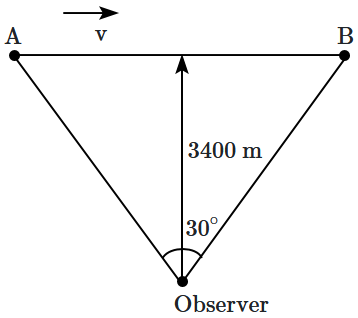
1. \(182~\text{m/s}\)
2. \(130~\text{m/s}\)
3. \(192~\text{m/s}\)
4. \(179~\text{m/s}\)
A bullet fired at an angle of 30° with the horizontal hits the ground 3.0 km away. By adjusting its angle of projection, can one hope to hit a target 5.0 km away? Assume the muzzle speed to be fixed, and neglect air resistance.
1. Yes
2. No
3. Depends on the mass of the bullet
4. None of the above


A fighter plane flying horizontally at an altitude of \(1.5~\text{km}\) with a speed of \(720~\text{km/hr}\) passes directly overhead an anti-aircraft gun. At what angle from the vertical should the gun be fired for the shell with muzzle speed \(600~\text{m/s}\)
| 1. | At an angle of \(\sin^{ - 1}(1/3)\) with the vertical. |
| 2. | |
| 3. | |
| 4. |

© 2026 GoodEd Technologies Pvt. Ltd.