
 Q. No.
The energy gap of silicon is 1.14 eV. The maximum wavelength at which silicon will begin absorbing energy is
(1) 10888 Å
(2) 1088.8 Å
(3) 108.88 Å
(4) 10.888 Å
(1) 10888 Å


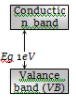
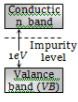
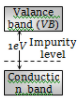
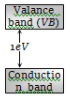
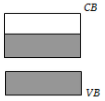
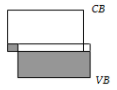
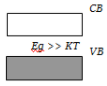
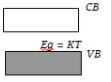
Which of the energy band diagrams shown in the figure corresponds to that of a semiconductor
1. 
2. 
3. 
4. 


The diagrams below show energy band structures for three silicon semiconductor samples labelled \(X,Y,\) and \(Z.\)

Based on these energy band diagrams, which statement correctly identifies the doping type for each sample?
| 1. | Sample \(X\) is undoped, while samples \(Y\) and \(Z\) have been doped with third-group and fifth-group impurities, respectively. |
| 2. | Sample \(X\) is undoped, while both samples \(Y\) and \(Z\) have been doped with fifth-group impurities. |
| 3. | Sample \(X\) has been doped with equal amounts of third- and fifth-group impurities, while samples \(Y\) and \(Z\) are undoped. |
| 4. | Sample \(X\) is undoped, while samples \(Y\) and \(Z\) have been doped with fifth-group and third-group impurities, respectively. |
In a semiconducting material, the mobilities of electrons and holes are \(\mu_e\) and \(\mu_{h}\) respectively. Which of the following is true?
1. \(\mu_{e} > \mu _{h}\)
2. \(\mu_{e} < \mu _{h}\)
3. \(\mu_{e} = \mu _{h}\)
4. \(\mu_{e} <0; ~\mu _{h}>0\)
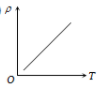
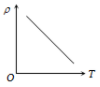
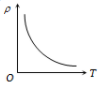
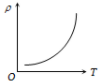
The temperature (T) dependence of resistivity () of a semiconductor is represented by
1. 
2. 
3. 
4. 


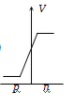
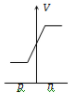
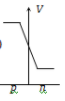
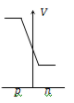
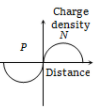
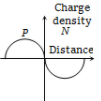
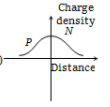
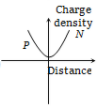
In a forward biased P-N junction diode, the potential barrier in the depletion region is of the form
1. 
2. 
3. 
4. 
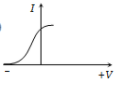
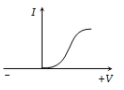
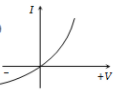
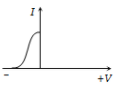
Different voltages are applied across a P-N junction and the currents are measured for each value. Which of the following graphs is obtained between voltage and current?
1. 
2. 
3. 
4. 
If the following input signal is sent through a PN-junction diode, then the output signal across will be
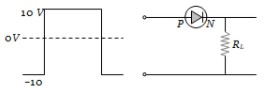
1. 
2. 
3. 
4. 



© 2026 GoodEd Technologies Pvt. Ltd.