 Q. No.
The effect of a catalyst in a chemical reaction is
to change the
1. Acivation energy
2. Equilibrium concentration
3. Heat of reaction
4. Final products
to change the
1. Acivation energy
2. Equilibrium concentration
3. Heat of reaction
4. Final products


The plot of log k vs helps to calculate :
1. Energy of activation.
2. Rate constant of reaction.
3. Order of the reaction.
4. Energy of activation as well as the frequency factor.
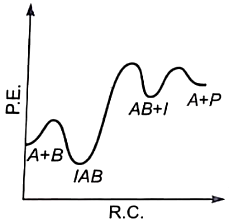
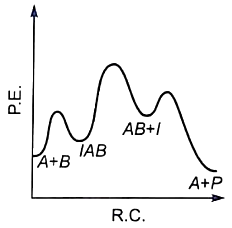
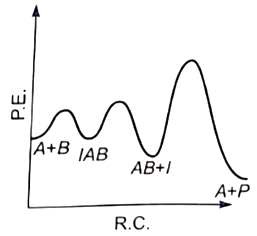
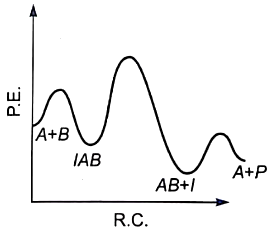


What is the temperature at which the rate constants of two reactions become equal, given that for reaction A → B,
k₁ = A₁ e (-Ea₁/RT) and for reaction X → Y, k₂ = A₂ e (-Ea₂/RT),
where A₁ = 108, A₂ = 1010, Ea₁ = 600 cal mol⁻¹, Ea₂ = 1800 cal mol⁻¹, and R = 2 cal K⁻¹ mol⁻¹?
1.
2.
3.
4.
A hydrogenation reaction is carried out at 500 K. When the same reaction is carried out in the presence of a catalyst, it proceeds at the same rate with the same frequency factor at 400 K.
The catalyst lowers the activation energy by 16 kJ mol⁻¹.
What is the activation energy of the uncatalyzed reaction (in kJ mol⁻¹)?
1. 100 kJ/mol
2. 80 kJ/mol
3. 60 kJ/mol
4. None of the above
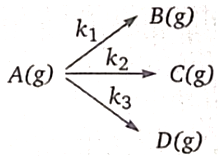


The gaseous decomposition reaction, A(g) 2B(g) + C(g) is observed to first order over the excess of liquid water at It is found that after 10 minutes the total pressure of the system is 188 torr and after a very long time, it is 388 torr. The rate constant of the reaction is :
[Given : vapour pressure of at is 28 torr (In 2 = 0.7, In 3 = 1.1, In 10 = 2.3)]
1. 0.02
2. 1.2
3. 0.2
4. None of these


1. \(3 \times 10^{-4} \mathrm{~mol} \mathrm{~L}^{-1} \mathrm{~s}^{-1} \)
2. \(4 \times 10^{-4} \mathrm{~mol} \mathrm{~L}^{-1} \mathrm{~s}^{-1} \)
3. \(6 \times 10^{-4} \mathrm{~mol} \mathrm{~L}^{-1} \mathrm{~s}^{-1} \)
4. \(1 \times 10^{-4} \mathrm{~mol} \mathrm{~L}^{-1} \mathrm{~s}^{-1}\)

© 2026 GoodEd Technologies Pvt. Ltd.