 Q. No.
The gaseous decomposition reaction, A(g) 2B(g) + C(g) is observed to first order over the excess of liquid water at It is found that after 10 minutes the total pressure of the system is 188 torr and after a very long time, it is 388 torr. The rate constant of the reaction is :
[Given : vapour pressure of at is 28 torr (In 2 = 0.7, In 3 = 1.1, In 10 = 2.3)]
1. 0.02
2. 1.2
3. 0.2
4. None of these


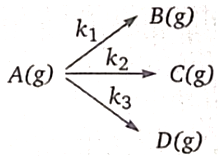


A hydrogenation reaction is carried out at 500 K. When the same reaction is carried out in the presence of a catalyst, it proceeds at the same rate with the same frequency factor at 400 K.
The catalyst lowers the activation energy by 16 kJ mol⁻¹.
What is the activation energy of the uncatalyzed reaction (in kJ mol⁻¹)?
1. 100 kJ/mol
2. 80 kJ/mol
3. 60 kJ/mol
4. None of the above
What is the temperature at which the rate constants of two reactions become equal, given that for reaction A → B,
k₁ = A₁ e (-Ea₁/RT) and for reaction X → Y, k₂ = A₂ e (-Ea₂/RT),
where A₁ = 108, A₂ = 1010, Ea₁ = 600 cal mol⁻¹, Ea₂ = 1800 cal mol⁻¹, and R = 2 cal K⁻¹ mol⁻¹?
1.
2.
3.
4.
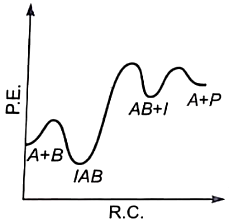
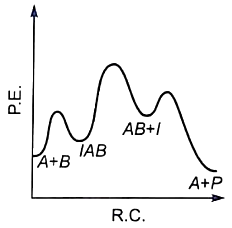
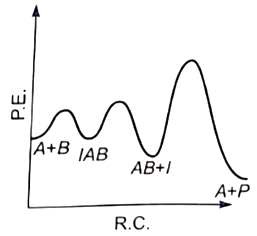


The plot of log k vs helps to calculate :
1. Energy of activation.
2. Rate constant of reaction.
3. Order of the reaction.
4. Energy of activation as well as the frequency factor.
The effect of a catalyst in a chemical reaction is
to change the
1. Acivation energy
2. Equilibrium concentration
3. Heat of reaction
4. Final products


1. \(3 \times 10^{-4} \mathrm{~mol} \mathrm{~L}^{-1} \mathrm{~s}^{-1} \)
2. \(4 \times 10^{-4} \mathrm{~mol} \mathrm{~L}^{-1} \mathrm{~s}^{-1} \)
3. \(6 \times 10^{-4} \mathrm{~mol} \mathrm{~L}^{-1} \mathrm{~s}^{-1} \)
4. \(1 \times 10^{-4} \mathrm{~mol} \mathrm{~L}^{-1} \mathrm{~s}^{-1}\)

© 2026 GoodEd Technologies Pvt. Ltd.