
 Q. No.
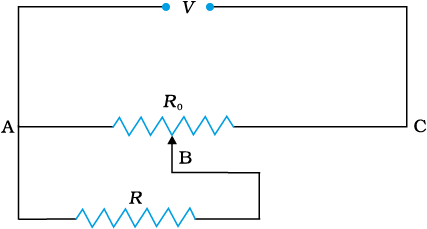
A resistance of draws current from a potentiometer. The potentiometer has a total resistance (as shown in the figure). A voltage V is supplied to the potentiometer. What is the voltage across R when the sliding contact is in the middle of the potentiometer?


A light bulb is rated at \(100~\text {W}\) for a \(220~\text {V}\) supply, the resistance of the bulb is:
1. \(423~\Omega\)
2. \(440~\Omega\)
3. \(444~\Omega\)
4. \(484~\Omega\)
Which one of the following is correct?
| 1. | After acquiring drift speed by the electrons, there is no acceleration of the electrons. |
| 2. | To have a large amount of electric current, the drift speed of the electrons should be very large. |
| 3. | When electrons drift in metal from lower to higher potential, all the free electrons move in the same direction. |
| 4. | The paths of the electrons between two successive collisions are curved in the presence of electric field. |


The curve in the given graph shows the variation of potential difference 'V' across a conductor with current 'I' flowing through a conductor. The dashed line in the graph given below represents:
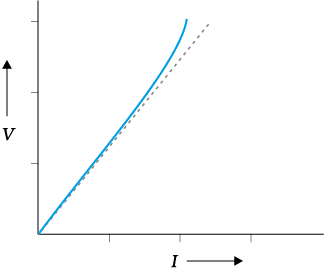
1. A non-ohmic conductor
2. An ohmic conductor
3. A semiconductor
4. An insulator
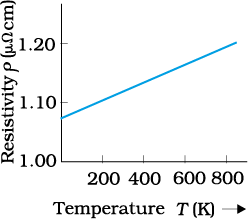
Graph shows the variation of resistivity with temperature for a material. The material can be-
1. Copper
2. Aluminum
3. GaAs
4. Nichrome
Match Column-I and Column-II with appropriate relations.
| Column-I | Column-II | ||
| \(\mathrm{(A)}\) | Drift Velocity | \(\mathrm{(P)}\) | \(\dfrac{{m}}{{ne}^2 \rho}\) |
| \(\mathrm{(B)}\) | Electrical Resistivity | \(\mathrm{(Q)}\) | \(nev_d\) |
| \(\mathrm{(C)}\) | Relaxation Period | \(\mathrm{(R)}\) | \(\dfrac{ {eE}}{{m}} \tau\) |
| \(\mathrm{(D)}\) | Current Density | \(\mathrm{(S)}\) | \(\dfrac{E}{J}\) |
| \(\mathrm{(A)}\) | \(\mathrm{(B)}\) | \(\mathrm{(C)}\) | \(\mathrm{(D)}\) | |
| 1. | \(\mathrm{(R)}\) | \(\mathrm{(P)}\) | \(\mathrm{(S)}\) | \(\mathrm{(Q)}\) |
| 2. | \(\mathrm{(R)}\) | \(\mathrm{(Q)}\) | \(\mathrm{(S)}\) | \(\mathrm{(P)}\) |
| 3. | \(\mathrm{(R)}\) | \(\mathrm{(S)}\) | \(\mathrm{(P)}\) | \(\mathrm{(Q)}\) |
| 4. | \(\mathrm{(R)}\) | \(\mathrm{(S)}\) | \(\mathrm{(Q)}\) | \(\mathrm{(P)}\) |


In a potentiometer circuit, a cell of emf \(1.5~\text{V}\) gives a balance point at 36 cm length of wire. If another cell of emf 2.5 V replaces the first cell, then at what length of the wire, the balance point occur?
1. 64 cm
2. 62 cm
3. 60 cm
4. 21.6 cm
The effective resistance of a parallel connection that consists of four wires of equal length, equal area of cross-section, and same material is \(0.25~\Omega\). What will be the effective resistance if they are connected in series?
1. \(1~\Omega\)
2. \(4~\Omega\)
3. \(0.25~\Omega\)
4. \(0.5~\Omega\)

1. \(\dfrac{r_1}{r_1+r_2}\)
2. \(\dfrac{r_2}{r_1+r_3}\)
3. \(\dfrac{r_1}{r_2+r_3}\)
4. \(\dfrac{r_2}{r_2+r_3}\)


In a meter bridge (shown in the figure), the null point is found at a distance of \(33.7\text{ cm}\) from \(A.\) If now a resistance of \(12~\Omega\) is connected in parallel with \(S,\) the null point occurs at \(51.9\text{ cm}.\) The values of \(R\) and \(S\) are respectively:

1. \(13.5~\Omega,~6.86~\Omega\)
2. \(13.5~\Omega,~13.5~\Omega\)
3. \(6.86~\Omega,~6.86~\Omega\)
4. \(6.86~\Omega,~13.5~\Omega\)

© 2026 GoodEd Technologies Pvt. Ltd.