 Q. No.
How many moles of HIO4 is required to break down the following molecule?

1. 1
2. 2
3. 3
4. 4
HIO4 के कितने मोल निम्नलिखित अणु को तोड़ने के लिए आवश्यक है?
1. 1
2. 2
3. 3
4. 4


Glucose and Mannose are
1. C1 epimers
2. Anomers
3. C2 epimers
4. C4 epimers
ग्लूकोज और मैनोज हैं
(1) C1 एपीमर
(2) ऐनोमर
(3) C2 एपीमर
(4) C4 एपीमर
Find iso-electric point of given amino acid
pKa = 2.2 pKb = 4.4
(1) 3.3
(2) 5.9
(3) 9.6
(4) 11.8
दिए गए एमीनो अम्ल का सम-विभव बिंदु ज्ञात कीजिए

pKa= 2.2 pKb = 4.4
(a) 3.3 (b) 5.9 (c) 9.6 (d) 11.8


Which of the following aldohexoses give the same osazone derivative ?

(1) I and IV
(2) I and III
(3) II and III
(4) III and IV
निम्नलिखित में से कौन सा एल्डोहेक्सोज समान ओसाजोन व्युत्पन्न देता है?
(1) I और IV
(2) I और III
(3) II और III
(4) III और IV
Which one is the complimentary base of adenine in one stand to that in the other stand of DNA?
(1) Cytosine
(2) Guanine
(3) Uracil
(4) Thymine
DNA के दूसरे रज्जुक में एक रज्जुक में ऐडेनीन का पूरक क्षार कौन सा है?
(1) साइटोसीन
(2) ग्वानीन
(3) यूरेसिल
(4) थायमीन
Which of the following is a non–reducing sugar ?
| (1) |  |
| (2) |  |
| (3) |  |
| (4) |  |
निम्नलिखित में कौन सी अनपचायी शर्करा है?
| (1) | |
| (2) | |
| (3) | |
| (4) | |


Which one of the following compounds will form an osazone derivative ?
1. CH3CH2COCH2OH
2. CH3COCH2CH2OH
3. CH3CH2CHOHCH2OH
4. CH3CH2COCH2OCH3
निम्नलिखित में से कौन सा यौगिक एक ओसाजोन व्युत्पन्न का निर्माण करेगा?
1. CH3CH2COCH2OH
2. CH3COCH2CH2OH
3. CH3CH2CHOHCH2OH
4. CH3CH2COCH2OCH3
D-Glucose→HNO3 (dil) A);
Product (A) is :-
Oxidation of Glucose with dil HNO3
(1) D-Gluconic acid
(2) D-Glucitol
(3) Sacchric acid
(4) D-Glucaric acid
D-ग्लूकोज A; उत्पाद (A) है:-
तनु HNO3 के साथ ग्लूकोज का ऑक्सीकरण
(a) D-ग्लूकोनिक अम्ल
(b) D-ग्लूकिटोल
(c) D-फ्रुक्टोज
(d) D-ग्लूकैरिक अम्ल
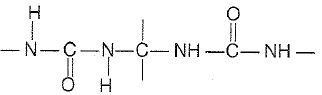
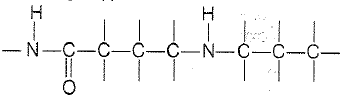
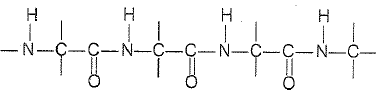
Which of the following structures represents the peptide chain ?
1. 
2. 
3. 
4. 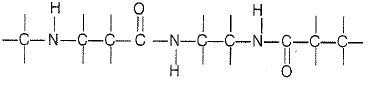
निम्नलिखित में से कौन सी संरचना पेप्टाइड श्रृंखला का प्रदर्शित करती है?


During the process of digestion, the proteins present in food materials are hydrolysed to amino acids. The two enzymes involved in the process
are respectively
1. amylase and maltase
2. diastase and lipase
3. pepsin and trypsin
4. invertase and zymase
पाचन के प्रक्रम के दौरान, खाद्य पदार्थों में उपस्थित प्रोटीन को एमीनो अम्ल में जलअपघटित किया जाता है। प्रक्रम में शामिल दो एंजाइम
क्रमशः हैं
(a) एमाइलेज और माल्टेज़
(b) डायस्टेज़ और लाइपेज़
(c) पेप्सिन और ट्रिप्सिन
(d) इन्वर्टेज़ और ज़ाइमेज़

© 2026 GoodEd Technologies Pvt. Ltd.