
 Q. No.
Propene upon heating with \(\mathrm{Cl}_2 \text { at } 500{ }^{\circ} \mathrm{C}\) forms:
1.
\(\mathrm{CH}_3-\mathrm{CHCl}-\mathrm{CH}_2 \mathrm{Cl} \)
2.
\(\mathrm{CH}_2 \mathrm{Cl}-\mathrm{CH}=\mathrm{CH}_2 \)
3.
\(\mathrm{CH}_2 \mathrm{Cl}-\mathrm{CHCl}-\mathrm{CH}_2 \mathrm{Cl} \)
4.
All of the above


On sulphonation of C6H5Cl, the product obtained is:
1. m-Chlorobenzene sulphonic acid is formed
2. Benzene sulphonic acid is formed
3. o-Chlorobenzene sulphonic acid is formed
4. o-and p-Chlorobenzene sulphonic acid is formed
Toluene on reaction with N-Bromosuccinimide gives
1. Phenyl bromomethane
2. o-Bromomethyl benzene
3. p-Bromomethyl benzene
4. m-Bromomethyl benzene


Addition of KI accelerates the hydrolysis of primary alkyl halides because:
1. KI is soluble in organic solvents
2. The iodide ion is a weak base and a poor leaving group
3. The iodide ion is a strong base
4. The iodide ion is a powerful nucleophile as well as a good leaving group
 (A) product


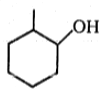


Which of the following compound would not give an E2 product when treated with sodium ethoxide?
1.

2.

3.

4.


© 2026 GoodEd Technologies Pvt. Ltd.