
Four charges of \(+1~\mu\text{C}\), \(+1~\mu\text{C}\), \(-1~\mu\text{C}\) and \(+1~\mu\text{C}\) are placed at the vertices of a square of side \(\sqrt{2}~\text{cm}\), in sequence. The net force experienced by \(0.1~\mu\text{C}\) charge at the centre of square:
1. \(9~\text{N}\)
2. \(18~\text{N}\)
3. \(36~\text{N}\)
4. Zero
1. \(9~\text{N}\)
2. \(18~\text{N}\)
3. \(36~\text{N}\)
4. Zero


Two short dipoles are placed at a certain distance exert a force 'F' on each other. If the distance between them is doubled then the force will become
1. F
2.
3. 4F
4.
The net dipole moment of the system is of the magnitude:

1. \(q\times 2a\)
2. \(2q \times 2a\)
3. \(q\times a\)
4. \(2\times (2q\times 2a)\)


The electric field calculated by Gauss's law is the field due to the charges which:
1. lie inside the Gaussian surface
2. lie outside the Gaussian surface
3. lie on the surface of the Gaussian surface
4. lie either inside, outside, or on the Gaussian surface
A small sphere of mass m and having charge q is suspended by a silk thread of length l in a uniform horizontal electric field. If it stands at a distance x from the vertical line from point of suspension, then the magnitude of the electric field is
1.
2.
3.
4.

The time period of the pendulum will:
1. Increase
2. Decrease
3. Remain the same
4. May increase or decrease


Two identical small metal spheres having charges \(q\) and \(-3q\) exert force \(F\) on each other. The spheres are touched with each other and then kept at the same separation. The magnitude of the new force between the spheres will be:
1. \(\frac{4}{3}F\)
2. \(4F\)
3. \(2F\)
4. \(\frac{F}{3}\)
| 1. | \(4~\text{cm}\) from \(2~\mu\text{C}.\) |
| 2. | \(2~\text{cm}\) from \(2~\mu\text{C}.\) |
| 3. | \(2~\text{cm}\) from \(8~\mu\text{C}.\) |
| 4. | \(3~\text{cm}\) from \(8~\mu\text{C}.\) |
At what distance from the larger point charge the electric field is zero?
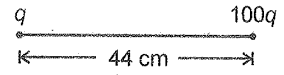
1. 4 cm
2. 11 cm
3. 22 cm
4. 40 cm


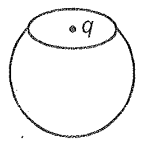
A point charge q is kept at the center of the circle formed by cutting a spherical shell by a plane as shown. The electric flux linked with the remaining surface of the shell is
1.
2.
3.
4.

© 2026 GoodEd Technologies Pvt. Ltd.