
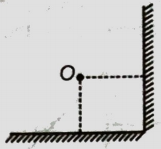
Two plane mirrors are placed perpendicular to each other as shown in the figure. An object O is kept at the angular bisector of the two mirrors. Numbers of images of object O is formed, will be:
1. 4
2. 3
3. 2
4. 1


Two convex lenses of focal lengths 10 cm and 30 cm are kept at a separation of 20 cm. Then the correct statement is:
(1) The effective focal length is 15 cm
(2) Chromatic aberration is minimized
(3) Combination behaves like a convergent lens
(4) All of these
If one surface of a biconvex lens is silvered, then it behaves as
(1) A concave mirror of focal length
(2) A concave mirror of focal length
(3) A convex mirror of focal length
(4) A concave mirror of focal length


An astronomical telescope has an angular magnification of 20 in its normal adjustment. The focal length of the eyepiece is 4 cm. Distance between objective and eyepiece is:
1. 80 cm
2. 84 cm
3. 76 cm
4. 90 cm
| 1. | a convergent with power \(P=\frac{1}{3 R}\) |
| 2. | a convergent with power \(P=\frac{1}{6 R}\) |
| 3. | a divergent with power \(P=\frac{1}{3 R}\) |
| 4. | a divergent with power \(P=\frac{1}{6 R}\) |
The thickness of a plano-convex glass lens in the middle is 1.5 cm. Viewing from the flat side the thickness of the lens at the centre will appear (refractive index of glass is 1.5) to be
1. 1.5 cm
2. 1.0 cm
3. 2 cm
4. 0.5 cm


A ray of light incident on an equilateral prism at an angle of incidence i. The deviation produced by prism will be maximum when angle i is [take ]
(1) 30
(2) 45
(3) 60
(4) 90
A lens of focal length \(f_{a}\) in air consists of a glass of refractive index \(\mu_{g}.\) If \(f_{l}\) is its focal length in a liquid of refractive index \(\mu_{l},\) then for \(\mu_{l}=\mu_{g}\)
1. \(f_{l}=0\)
2. \(\infty >f_{l}>f_{a}\)
3. \(0<f_{l}<f_{a}\)
4. \(f_{l}=\infty \)
If four convex lenses, given to you have focal lengths , then which of the following combination will you prefer to form a compound microscope?
(1) as objective and as eye-lens
(2) as objective and as eye-lens
(3) as objective and as eye-lens
(4) as objective and as eye-lens


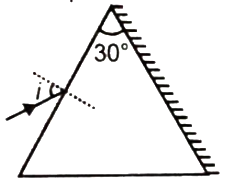
A light ray is incident on a prism of refracting angle . The refractive index of prism is , then for what value of angle of incidence, the ray will retrace its path?
1.
2.
3.
4.

© 2026 GoodEd Technologies Pvt. Ltd.