
Two toroids \(1\) and \(2\) have total no. of turns \(200\) and \(100\) respectively with average radii \(40~\text{cm}\) and \(20~\text{cm}\) respectively. If they carry the same current \(i,\) what will be the ratio of the magnetic fields along the two loops?
1. \(1:1\)
2. \(4:1\)
3. \(2:1\)
4. \(1:2\)
1. \(1:1\)
2. \(4:1\)
3. \(2:1\)
4. \(1:2\)


| 1. | zero | 2. | \(\dfrac{3\mu_0 i}{32R},~\text{inward}\) |
| 3. | \(\dfrac{3\mu_0 i}{32R},~\text{outward}\) | 4. | \(\dfrac{\mu_0 i}{2R},~\text{inward}\) |

| 1. | \(I_1=3 A\) into the paper | 2. | \(I_2=3 A\) out of the paper |
| 3. | \(I_3=0\) | 4. | \(I_3=1 A\) out of the paper |


A galvanometer has a resistance of 3663 . A shunt S is connected across it such that 1/34 of the total current passes through the galvanometer. The value of the shunt is :
(1) 3663
(2) 111
(3) 107.7
(4) 3555.3
A candidate connects a moving coil voltmeter \(V\), a moving coil ammeter \(A\), and a resistor \(R\) as shown in Fig. 6.58. If the voltmeter reads \(20~\text{V}\) and the ammeter reads \(4~\text{A}\), \(R\) is:
1. equal to \(5~\Omega\)
2. greater than \(5~\Omega\)
3. less than \(5~\Omega\)
4. greater or less than \(5~\Omega\) depending upon its material.

A milliammeter of range 10 mA and resistance 9 is joined in a circuit as shown in Fig. 6.57. The meter gives full-scale deflection for current I when A and C are used as its terminals if current enter at A and leaves at C (B is left isolated). The value of I is :

(1)100 mA
(2) 900 mA
(3) 1 A
(4) 1.1 A


2. Westward
3. Northward
4. Southward
The endpoints of a current-carrying wire lie on the x-axis and y-axis as shown. The magnetic force on the wire is:
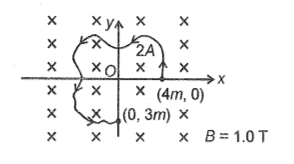
1. Zero
2. 6 N
3. 8 N
4. 10 N
The given figure shows a semicircular loop of radius R carrying current I and is placed in a uniform magnetic field B. The force acting on the semicircular part of the loop is
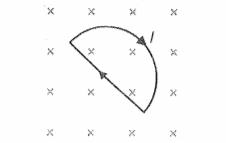
1.
2.
3.
4.


A non-conducting rod AB of length L has a positive linear charge density . This rod is rotated about its one end with an angular speed as shown. The magnetic moment associated with this rod is-
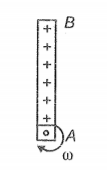
1. λ
2. λ
3.
4.

© 2026 GoodEd Technologies Pvt. Ltd.