
What is true A,B and C in the given diagrammatic representation of rDNA technology ?
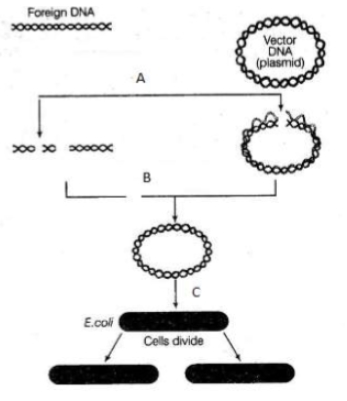
| I: | At A same restriction enzyme is used to cut both foreign and vector DNA |
| II: | The enzyme used at B is DNA ligase |
| III: | Step C can be called as transformation |
| 1. | I and II only |
| 2. | I and III only |
| 3. | II and III only |
| 4. | I,II and III |


In 1960’s two enzymes were discovered in bacteria that were responsible for providing immunity against bacteriophages. One was Restriction Endonuclease and the other was
1. Methylase
2. Exonuclease
3. Aminotransferase
4. Terminal Transferase
The names associated with construction of first Recombinant DNA are
| 1. | Arber, Nathans, Smith |
| 2. | Annie Chang, Boyer, Berg, Cohen |
| 3. | Howard Temin, Brenner, Sharp |
| 4. | Tim Hunt, Hartwell, Nurse |



Restriction enzymes do not act on the the DNA of the Host cell in which they are produced because
| 1. | Host DNA is packed into chromosomes |
| 2. | Restriction enzymes are ineffective on host DNA |
| 3. | Host DNA does not have the restriction site for the Restriction enzymes. |
| 4. | Restriction site of host DNA is methylated. |
Arrange the following enzymes/ processes in the order of their use for a certain experiment of genetic engineering:
1) ligase,
2) restriction enzyme
3)desired gene
4) Transformation
5) Expression
1. 3-2-1-4-5
2. 1-2-4-5-3
3. 3-1-4-5-2
4. 2-5-4-3-1
Which of the following is not a tool of RDT?
1. PCR
2. Restriction enzymes
3. Vectors
4. Host organisms


Which of the following is a tool of RDT?
| 1. | PCR | 2. | Gel Electrophoresis |
| 3. | Cloning | 4. | Restriction enzyme |
Arrange the following steps in order:
1) Restriction Digestion
2) Running Agarose gel
3) Elution of bands
4) Purification of DNA
5) ligation
6) transformation
7) Cloning
1. 1-2-3-4-5-6-7
2. 1-5-6-7-2-3-4
3. 1-2-3-5-6-7-4
4. 2-3-4-1-5-6-7
The first type II restriction endonuclease whose functioning depended on a specific DNA nucleotide sequence was:
1. EcoRI
2. HindII
3. SmaI
4. BamHI


Match the following enzymes with their functions:
|
Column-I |
Column-II |
||
|
(a) |
Restriction endonuclease |
(i) |
joins the DNA fragments |
|
(b) |
Exonuclease |
(ii) |
extends primers on genomic DNA template |
|
(c) |
DNA ligase |
(iii) |
cuts DNA at a specific position |
|
(d) |
Tag polymerase |
(iv) |
removes nucleotides from the ends of DNA |
Select the correct option from the following:
| Options: | (a) | (b) | (c) | (d) |
| 1. | (iii) | (i) | (iv) | (ii) |
| 2. | (iii) | (iv) | (i) | (ii) |
| 3. | (iv) | (iii) | (i) | (ii) |
| 4. | (ii) | (iv) | (i) | (iii) |

© 2026 GoodEd Technologies Pvt. Ltd.