
At which step, glycolysis reaches the break-even point where 2
molecules of ATP consumed, and 2 new molecules synthesized?
| 1. | Splitting of fructose-6-phosphate into two trioses |
| 2. | Conversion of 1,3 bi-phosphoglycerate to 3 phosphoglycerate |
| 3. | Conversion of GADP to 1,3 biphosphoglycerate |
| 4. | Conversion of DHAP to GADP |


Sucrose is converted into glucose and fructose by the enzyme:
1. Maltase
2. Zymase
3. Isomerase
4. Invertase

During glycolysis, when glucose is catabolized to pyruvate, most of the energy of glucose is
| 1. | transferred to ADP, forming ATP. |
| 2. | transferred directly to ATP. |
| 3. | retained in the pyruvate. |
| 4. | stored in the NADH produced. |


ATP production during cellular respiration is controlled by allosteric inhibition. The control is the allosteric inhibition by ATP and citric acid of the enzyme that facilitates the formation of:
| 1. | Glucose 6- phosphate from glucose |
| 2. | Fructose 1,6- bisphosphate from Fructose 6 - phosphate |
| 3. | Acetyl CoA from Pyruvic acid |
| 4. | Citric acid from Acetyl CoA and Oxaloacetic acid |
The three boxes in this diagram represent the three major biosynthetic pathways in
aerobic respiration. Arrow represent net reactants or products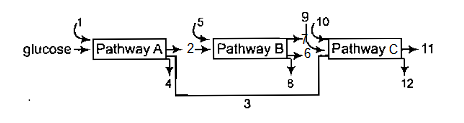
Arrows numbered 4, 8, 12 can all be
1. NADH
2. ATP
3. H2O
4. FAD+ or FADH2
How many ATP molecules could maximally be generated from one molecule of glucose, if
the complete oxidation of one mole of glucose to CO2 and H2O yields 686 kcal and the
useful chemical energy available in the high energy phosphate bond of one mole of ATP is
12 Kcal?
1. Two
2. Thirty
3. Fifty seven
4. One


In respiration from 180g of glucose which of the following is formed?
1. 264gm CO2+190gm H2O+391 Kcal
2. 264gm CO2+108gm H2O+686 Kcal
3. 390gm CO2+108gm H2O+686 Kcal
4. 390gm CO2+ 264gm H2O+391 Kcal
Glycolysis is found in cytoplasm of virtually all types of aerobic/anaerobic cells. In this
process, glucose is converted into :
1. PEP
2. acetyl CoA
3. pyruvic acid
4. citric acid.
Which one is correct sequence occuring in glycolysis?
1. G-6-P PEP 3-PGAL 3-PGA
2. G-6-P 3-PGAL 3-PGA PEP
3. G-6-P PEP 3-PGA 3-PGAL
4. G-6-P 3-PGA 3-PGAL PEP


In which of the following reactions of glycolysis, a molecule of water is removed from the substrate?
1. Glucose Glucose-6-phosphate
2. Fructose-6-phosphate Fructose-1,6 bisphosphate
3. 2-phosphoglycerate Phosphoenol pyruvate
4. Phosphoenol pyruvate Pyruvate

© 2026 GoodEd Technologies Pvt. Ltd.