Pneumatophores are seen in:

1. Rhizophora

2. Banyan tree

3. Carrot

4. Turnip

Subtopic:  Modification of Roots |
 94%
Level 1: 80%+
Hints
Links

Some foliar roots also produce adventitious roots as in:

1. Oxalis

2. Coleus

3. Tapioca

4. Bryophyllum

Subtopic:  Morphology of Roots | Modification of Roots |
 57%
Level 3: 35%-60%
Hints

Plants, which produce characteristic pneumatophores and show vivipary belong to

(1) mesophytes

(2) halophytes

(3) psammophytes

(4) hydrophytes

Subtopic:  Modification of Roots |
 69%
Level 2: 60%+
NEET - 2017
Hints

advertisementadvertisement

Roots play insignificant role in absorption of water in

1. sunflower

2. Pistia

3. pea

4. wheat

Subtopic:  Morphology of Roots | Modification of Roots |
 68%
Level 2: 60%+
NEET - 2015
Hints

premium feature crown icon
Unlock IMPORTANT QUESTION
This question was bookmarked by 5 NEET 2025 toppers during their NEETprep journey. Get Target Batch to see this question.
✨ Perfect for quick revision & accuracy boost
Buy Target Batch
Access all premium questions instantly

Velamen is a specialized tissue found in

(1) aerial roots of orchids

(2) succulent leaves

(3) pneumatophores

(4) stilt roots

Subtopic:  Modification of Roots |
 60%
Level 2: 60%+
Hints

premium feature crown icon
Unlock IMPORTANT QUESTION
This question was bookmarked by 5 NEET 2025 toppers during their NEETprep journey. Get Target Batch to see this question.
✨ Perfect for quick revision & accuracy boost
Buy Target Batch
Access all premium questions instantly

Which of the following is the largest root parasite?

(1) Rafflesia

(2) Areuthobium

(3) Monotrapa

(4) Pistia

Subtopic:  Morphology of Roots | Modification of Roots |
 61%
Level 2: 60%+
Hints

advertisementadvertisement

premium feature crown icon
Unlock IMPORTANT QUESTION
This question was bookmarked by 5 NEET 2025 toppers during their NEETprep journey. Get Target Batch to see this question.
✨ Perfect for quick revision & accuracy boost
Buy Target Batch
Access all premium questions instantly

Velamen present in orchids helps in

(1) absorption of nutrients from host plant

(2) respiration

(3) absorption of moisture from air

(4) synthesising food

Subtopic:  Modification of Roots |
 62%
Level 2: 60%+
Hints

premium feature crown icon
Unlock IMPORTANT QUESTION
This question was bookmarked by 5 NEET 2025 toppers during their NEETprep journey. Get Target Batch to see this question.
✨ Perfect for quick revision & accuracy boost
Buy Target Batch
Access all premium questions instantly

Which among the following is a rootless plant?

(1) Nymphaea

(2) Sagittaria

(3) Ceratophyllum

(4) Vallisneria

Subtopic:  Modification of Roots |
Level 4: Below 35%
Hints

Which of the following is correctly matched?

1. Monstera - Fibrous root

2. Dahlia - Fasciculated root

3. Azadirachta - Adventitious root

4. Basil - Prop roots

Subtopic:  Morphology of Roots | Modification of Roots |
 51%
Level 3: 35%-60%
Hints

advertisementadvertisement

Identify the type of root given in the figure, from the given options.
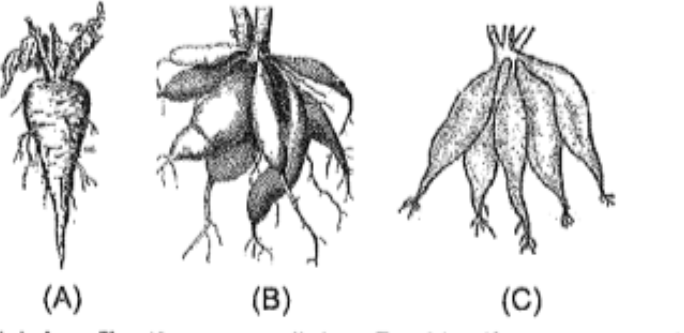
(1) A–Fusiform, radish; B–Napiform, turmeric; C–Tuberous, sweet potato

(2) A–Conical, turnip; B–Nodulated, sweet potato; C–Tuberous, Curcuma amada

(3) A–Conical, carrot; B–Tuberous, sweet potato; C–Fasciculated, Dahlia

(4) A–Napiform, carrot; B–Nodulated, Tamarind; C–Tuberous, turmeric

Subtopic:  Morphology of Roots | Modification of Roots |
 68%
Level 2: 60%+
Hints


