
Identify the incorrect statement regarding green algae?
| 1. | They contain chl a, chl b as well as carotenoids. |
| 2. | The chloroplasts may be discoid, plate-like, reticulate, cup-shaped, spiral or ribbon-shaped in different species. |
| 3. | Most members have one or more storage bodies called pyrenoids located outside the chloroplasts. |
| 4. | They usually have a rigid cell wall made of an inner layer of cellulose and an outer layer of pectose. |


Which pair[s] is/are in incorrectly matched?
I. Phaeophyceae - Algin in cell wall
II. Chlorophyceae - Laminarin is stored food
III. Rhodophyceae - 2, unequal, lateral flagella
1. Only II
2. Only III
3. I and II only
4. II and III only
In the given diagrams, some of the algae have been labelled as A, B, C, D and E. Choose the correct option to identify these algae.
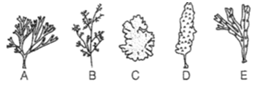
| A | B | C | D | E | |
| 1. | Dictyota | Polysiphonia | Porphyra | Fucus | Laminaria |
| 2. | Porphyra | Dictyota | Laminaria | Fucus | Polyspiphonia |
| 3. | Dictyota | Polysiphonia | Porphyra | Laminaria | Fucus |
| 4. | Fucus | Porphyra | Dictyota | Polysiphonia | Laminaria |


Chloroplasts can be discoid, plate-like, reticulate, cup-shaped, spiral or ribbon-shaped in different species. Such variety can be found in
| 1. | Chlorophyceae | 2. | Phaeophyceae |
| 3. | Rhodophyceae | 4. | All of these |
Pyrenoid is
| 1. | Storage bodies located in cytoplasm of chloropbyceae |
| 2. | Storage bodies located in cytoplasm of Phaeophyceae |
| 3. | Storage bodies located in chloroplast of chlorophyceae |
| 4. | Storage bodies located in chloroplast of Phaeophyceae |
Green algae usually have a rigid cell wall made of an inner layer of ….…. and outer layer of ………
| 1. | Pectose, Cellulose |
| 2. | Cellulose, Pectose |
| 3. | Algin, carrageenan |
| 4. | Carrageen, Algin |


Vegetative reproduction in chlorophyceae takes place by
| 1. | Fragmentation | 2. | Only spore formation |
| 3. | Anisogamous | 4. | Isogamous |
Asexual reproduction in chlorophyceae is by
| 1. | Zoospore formation in Antheriodiophore |
| 2. | Fragmentation |
| 3. | Zoospore formation in Zoosporangia |
| 4. | Both 1 and 2 |


Zoospore formed during asexual reproduction in chlorophyceae are
| 1. | Flagellated | 2. | Non-flagellated |
| 3. | Ciliated | 4. | Non ciliated |

© 2026 GoodEd Technologies Pvt. Ltd.