
Fungi usually store the reserve food material in the form of
(1) Starch
(2) Glycogen and oil
(3) Lipid
(4) Protein


Consider the following characters:
I. Heterotroph organisms
II. A dikaryon stage
III. Cell wall made of chitin
IV. Undergo nuclear mitosis
Which of the above relate to fungi?
1. I, II and III
2. I, III and IV
3. II, III and IV
4. I, II, III and IV
How many of the following statements regarding fungi are true?
| I. | Asexual reproduction is common by the formation of spores. |
| II. | Their bodies consist of hyphae that may be interconnected to form mycelium. |
| III. | They secrete digestive enzymes onto organic matter and then absorb the products of the digestion. |
| IV. | Fungi can break down almost any carbon containing product. |
| V. | Fungi do not enter symbiotic relationships. |
1. 2
2. 3
3. 4
4. 5



Consider the following characters:
I. Nuclear envelope
II. Membranes lacking sterols
III. 80s ribosomes
IV. split genes
The character not shared by fungi with other eukaryotes is/are:
(1) II alone
(2) IV alone
(3) II and IV only
(4) III and IV only
Fungi resemble plants in:
(1) Lack of chloroplasts and heterotrophic nutrition
(2) Reproduction by only sexual means
(3) Having a cell wall and vacuoles
(4) Exhibition of bioluminiscence
Identify the characteristic that is unique to fungi:
(1) Cell wall of glucans and chitin
(2) Lack of chloroplasts and heterotrophic nutrition
(3) Mannitol, trehalose and glycogen as storage products.
(4) Having haploid nuclei and production of spores


Which one of the following is wrong for fungi?
1. They are eukaryotic
2. All fungi possess a purely cellulosic cell wall
3. They are heterotrophi
4. They are both unicellular and multicellular
One of the major components of cell wall of most fungi is
1. peptidoglycan
2. cellulose
3. hemicellulose
4. chitin
Cellulose is the major component of cell walls of
(1) Pythium
(2) Xanthomonas
(3) Pseudomonas
(4) Saccharomyces


The given below figure shows a generalised life cycle of a fungus. Identify A, B and C from the given option.
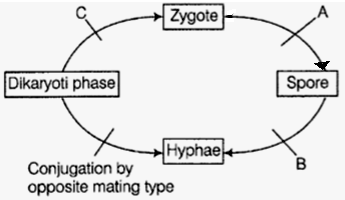
| A | B | C |
(1) | Meiosis | Fertilisation | Meiosis |
(2) | Meiosis | Mitosis | Fertilisation |
(3) | Mitosis | Meiosis | Fertilisation |
(4) | Mitosis | Fertilisation | Meiosis |

© 2026 GoodEd Technologies Pvt. Ltd.