
In the diagram, two sinusoidal voltages of the same frequency are shown. What is the frequency and the phase relationship between the voltages?

| Frequency in Hz | Phase lead of \(N\) over \(M\) in radians | |
| 1. | \(0.4\) | \(-\pi/4\) |
| 2. | \(2.5\) | \(-\pi/2\) |
| 3. | \(2.5\) | \(+\pi/2\) |
| 4. | \(2.5\) | \(-\pi/4\) |


An ideal inductor connected to a cell is shown in figure. Select the correct relations between readings of ammeters just after the switch is closed and a long time after closing the switch
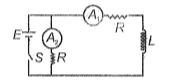
A direct current of \(2~\text{A}\) and an alternating current having peak value \(2~\text{A}\) flow through two identical resistances at the same time. The ratio of heat produced in the two resistance will be:
1. \(1:1\)
2. \(1:2\)
3. \(2:1\)
4. \(4:1\)


Given that the current \(i_1=3A \sin \omega t\) and the current \(i_2=4A \cos \omega t,\) what will be the expression for the current \(i_3\)?

1. \(5 A \sin \left(\omega t+53^{\circ}\right) \)
2. \(5 A \sin \left(\omega t+37^{\circ}\right) \)
3. \(5 A \sin \left(\omega t+45^{\circ}\right) \)
4. \( 5 A \sin \left(\omega t+30^{\circ}\right)\)
| Assertion (A): | When a current \(I=(3+4 \sin \omega t)\) flows in a wire, then the reading of a dc ammeter connected in series is \(4\) units. |
| Reason (R): | A dc ammeter measures only the value of the current amplitude. |
| 1. | Both (A) and (R) are True and (R) is the correct explanation of (A). |
| 2. | Both (A) and (R) are True but (R) is not the correct explanation of (A). |
| 3. | (A) is True but (R) is False. |
| 4. | Both (A) and (R) are False. |
Given below are two statements:
| Statement I: | DC and AC both can be measured by a hot wire instrument. |
| Statement II: | A hot wire instrument works on the principle of the magnetic effect of current. |
| 1. | Statement I is false but Statement II is true. |
| 2. | Both Statement I and Statement II are true. |
| 3. | Both Statement I and Statement II are false. |
| 4. | Statement I is true but Statement II is false. |


When 100 volt d.c. is applied across a solenoid, a current of 1.0 A flows in it. When 100 volt a.c. is appliead across the same coil, the current drops to 0.5 A. If the frequency of a.c. source is 50 Hz the impedance and inductance of the solenoid is
1. 200 and 0.55 H
2. 100 and 0.86 H
3. 200 and 1.0 H
4. 100 and 0.93 H
| (a) | zero average current |
| (b) | \(220~\text V\) average voltage |
| (c) | voltage and current out of phase by \(90^\circ\) |
| (d) | voltage and current possibly differing in phase \(\phi\) such that \(|\phi|<\dfrac \pi 2.\) |
Choose the correct options:
1. (b), (c)
2. (a), (d)
3. (b), (d)
4. (a), (c)

© 2026 GoodEd Technologies Pvt. Ltd.