

A man drops a stone into a lake from the top of a tower that is \(500~\text{m}\) high. If the speed of sound in air is \(340~\text{m/s},\) approximately how long after releasing the stone will he hear the sound of the splash? \(\left(\text{take }g=10~\text{m/s}^2\right)\)
1. \(11.5~\text{s}\)
2. \(21~\text{s}\)
3. \(10~\text{s}\)
4. \(14~\text{s}\)


A point source emits sound equally in all directions in a non-absorbing medium. Two points P and Q are at a distance of 2m and 3m respectively from the source. The ratio of the intensities of the waves at P and Q is :
(1) 9 : 4
(2) 2 : 3
(3) 3 : 2
(4) 4 : 9
If the pressure amplitude in a sound wave is tripled, then the intensity of sound is increased by a factor of
(1) 9
(2) 3
(3) 6
(4)


The ends of a stretched wire of length L are fixed at x = 0 and x = L. In one experiment, the displacement of the wire is and energy is E1, and in another experiment its displacement is and energy is E2. Then :
(1) E2 = E1
(2) E2 = 2E1
(3) E2 = 4E1
(4) E2 = 16E1
Consider ten identical sources of sound all giving the same frequency but having phase angles which are random. If the average intensity of each source is I0, the average of resultant intensity I due to all these ten sources will be :
(1) I = 100 I0
(2) I = 10 I0
(3) I = I0
(4)
Two identical pulses in a stretched string, initially \(8\) cm apart, are moving toward each other as shown in the figure. The speed of each pulse is \(2\) cm/s. What will be the total energy of the pulses after \(2~\text{s}\text{?}\)

1. Zero
2. Purely kinetic
3. Purely potential
4. Partly kinetic and partly potential


The displacement-time graphs for two sound waves A and B are shown in the figure, then the ratio of their intensities IA/IB is equal to :

1. 1 : 4
2. 1 : 16
3. 1 : 2
4. 1 : 1
Two pulses is a stretch string whose centers are initially 8 cm apart are moving towards each other as shown in the figure. The speed of each pulse is 2 cm/s . After 2 seconds, the total energy of the pulses will be:
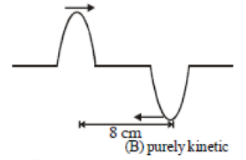
1. zero
2. Purely kinetic
3. Purely potential
4. Partly kinetic and partly potential
Two wave trains, with intensities I and 2I respectively arrive and superpose at a point P in opposite phases. The amplitude of the superposed wave at P at that instant will be proportional to,
1.
2.
3.
4.


Assertion: In a stationary wave, there is no transfer to energy.
Reason: There is no outward motion of the disturbance from one particle to adjoining particle in a stationary wave.
- If both the assertion and the reason are true and the reason is a correct explanation of the assertion
- If both the assertion and reason are true but the reason is not a correct explanation of the assertion
- If the assertion is true but the reason is false
- If both the assertion and reason are false

© 2026 GoodEd Technologies Pvt. Ltd.