

The gravitational field due to a mass distribution is given by , where k is a constant. Assuming the potential to be zero at infinity, find the potential at a point x = a.[This question includes concepts from Gravitation chapter]
1.
2.
3.
4.


The gravitational potential difference between the surface of a planet and 10 m above is 5 J/kg. If the gravitational field is supposed to be uniform, the work done in moving a 2 kg mass from the surface of the planet to a height of 8 m is
1. 2J
2. 4J
3. 6J
4. 8J
Four particles each of mass M, are located at the vertices of a square with side L. The
gravitational potential due to this at the centre of the square is
1.
2.
3. zero
4.


The gravitational field due to a mass distribution is in the x-direction. (K is a
constant). Taking the gravitational potential to be zero at infinity, its value at a distance x
is
1. K/x
2. K/2x
3.
4. K/2
The diagram showing the variation of gravitational potential of earth with distance r from the centre of earth is -
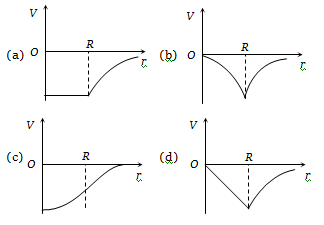
| 1. |  |
2. |  |
| 3. |  |
4. |  |
At what height from the surface of earth the gravitation potential and the value of g are and respectively? (Take, the radius of earth as 6400 km.)
1. 1600 km
2. 1400 km
3. 2000 km
4. 2600 km


Infinite number of bodies, each of mass 2 kg are situated on x-axis at distance 1m, 2m, 4m, 8m, respectively from the origin. The resulting gravitational potential due to this system at the origin will be
1. -G
2. -8/3G
3. -4/3G
4. -4G
A particle of mass M is situated at the centre of a spherical shell of mass M and radius a.The gravitational potential at a point situated at a/2 distance from the centre will be
1. 2.
3. 4.
Mass and radius of the earth is M and R respectively, then the gravitational potential at a distance R/3 from the centre of the earth is
1.
2.
3.
4.


(Take, the radius of the earth as \(6400~\text{km}\))
2. \(1400~\text{km}\)
3. \(2000~\text{km}\)
4. \(2600~\text{km}\)

© 2026 GoodEd Technologies Pvt. Ltd.