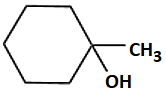
An organic compound A reacts with sodium metal and forms B. On heating with conc. H2SO4, A gives diethyl ether. So A and B are:
1. C3H7OH and CH3ONa
2. CH3OH and CH3ONa
3. C4H9OH and C4H9ONa
4. C2H5OH and C2H5ONa

Subtopic:  Alcohols: Preparation & Properties | Mechanism of Dehydration, Methanol & Ethanol |
 80%
Level 1: 80%+
Hints

Widespread deaths due to liquor poisoning occur due to the presence of-
1. Lead compounds in liquor 2. Methyl alcohol in liquor
3. Ethyl alcohol in liquor 4. Carbonic acid in liquor
Subtopic:  Mechanism of Dehydration, Methanol & Ethanol |
 79%
Level 2: 60%+
Hints

Upon dehydration, the below mentioned compound will not give:

1.  2.  
3.    4.  
Subtopic:  Mechanism of Dehydration, Methanol & Ethanol |
 74%
Level 2: 60%+
Hints

advertisementadvertisement

premium feature crown icon
Unlock IMPORTANT QUESTION
This question was bookmarked by 5 NEET 2025 toppers during their NEETprep journey. Get Target Batch to see this question.
✨ Perfect for quick revision & accuracy boost
Buy Target Batch
Access all premium questions instantly

Consider the following alcohols,

I.
II.
III.
IV.

Ease of dehydration of the above alcohols will be in the order of:

1. I < II < III < IV 2. I > II > III > IV
3. III  < II < I < IV 4. II < III < IV < I
Subtopic:  Mechanism of Dehydration, Methanol & Ethanol |
 68%
Level 2: 60%+
Hints

The best method to prepare cyclohexene from cyclohexanol is by using:

1. conc. HCl + ZnCl2 2. conc. H3PO4
3. HBr 4. conc. HCl
Subtopic:  Alcohols: Preparation & Properties | Mechanism of Dehydration, Methanol & Ethanol |
 72%
Level 2: 60%+
Hints

"A" and "B" are respectively:

 
A B
1.     
2. 
3.   
4.   

Subtopic:  Mechanism of Dehydration, Methanol & Ethanol |
 60%
Level 2: 60%+
Hints

advertisementadvertisement

premium feature crown icon
Unlock IMPORTANT QUESTION
This question was bookmarked by 5 NEET 2025 toppers during their NEETprep journey. Get Target Batch to see this question.
✨ Perfect for quick revision & accuracy boost
Buy Target Batch
Access all premium questions instantly

What is the correct order of dehydration rate for the compounds (i), (ii), and (iii) when treated with concentrated \(\text{H}_2\text{SO}_4\)?

(i) 
(ii) 
(iii)

1. (i) > (iii) > (ii)                                             

2. (i) > (ii) > (iii)

3. (ii) > (i) > (iii)                                             

4. (ii) > (iii) > (i)

Subtopic:  Mechanism of Dehydration, Methanol & Ethanol |
 65%
Level 2: 60%+
Hints

premium feature crown icon
Unlock IMPORTANT QUESTION
This question was bookmarked by 5 NEET 2025 toppers during their NEETprep journey. Get Target Batch to see this question.
✨ Perfect for quick revision & accuracy boost
Buy Target Batch
Access all premium questions instantly

Optically active 2-octanol rapidly loses its optical activity when exposed to :

1. Dilute acid 2. Dilute base
3. Light 4. Humidity
Subtopic:  Alcohols: Preparation & Properties | Mechanism of Dehydration, Methanol & Ethanol |
 58%
Level 3: 35%-60%
Hints

The most reactive compound among the following toward electrophilic aromatic substitution reaction is:

1.  2.
3.   4.   
 

Subtopic:  Mechanism of Dehydration, Methanol & Ethanol |
 56%
Level 3: 35%-60%
AIPMT - 2011
Hints

advertisementadvertisement

premium feature crown icon
Unlock IMPORTANT QUESTION
This question was bookmarked by 5 NEET 2025 toppers during their NEETprep journey. Get Target Batch to see this question.
✨ Perfect for quick revision & accuracy boost
Buy Target Batch
Access all premium questions instantly

The proposed mechanism for hydration of ethene to yield ethanol is as follows:

The wrong step in the above mechanism is:

1. Step 1 2. Step 2
3. Step 3 4. Both steps 2 and 3
Subtopic:  Mechanism of Dehydration, Methanol & Ethanol |
Level 3: 35%-60%
Hints