
 Q. No.
A diagram showing the axon terminal and synapse is given. Identify correctly at least two of A-D:
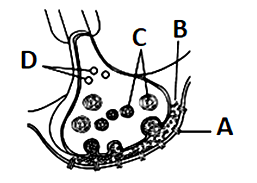
1. B- Synaptic connection; D- K+
2. A- Neurotransmitter; B- Synaptic cleft
3. C- Neurotransmitter; D- Ca++
4. A- Receptor; C- Synaptic vesicles


The human hindbrain comprises three parts, one of which is:
| 1. | Cerebellum | 2. | Hypothalamus |
| 3. | Spinal | 4. | Corpus callosum |
| 1. | equally permeable to both Na+ and K+ ions |
| 2. | impermeable to both Na+ and K+ ions |
| 3. | comparatively more permeable to K+ ions and nearly impermeable to Na+ ions |
| 4. | comparatively more permeable to Na+ ions and nearly impermeable to K+ ions |


The nerve centres which control the body temperature and the urge for eating are contained in:
1. hypothalamus
2. pons
3. cerebellum
4. thalamus
Which part of the human brain is concerned with the regulation of body temperature?
1. Medulla oblongata
2. Cerebellum
3. Cerebrum
4. Hypothalamus
Alzheimer disease in humans is associated with the deficiency of:
1. dopamine
2. glutamic acid
3. acetylcholine
4. Gamma Amino Butyric Acid (GABA)
1. K+ ions from extracellular fluid to intracellular fluid
2. Na+ ions from intracellular fluid to extracellular fluid
3. K+ ions from intracellular fluid to extracellular fluid
4. Na+ ions from extracellular fluid to intracellular fluid
During the transmission of nerve impulses through a nerve fibre, the potential on the inner side of the plasma membrane has which type of electric charge?
| 1. | First negative, then positive, and again back to negative |
| 2. | First positive, then negative, and continue to be negative |
| 3. | First negative, then positive, and then continues to be positive |
| 4. | First positive, then negative, and again back to positive |
Which one of the following pairs of structures distinguishes a nerve cell from other types of cells?
1. Perikaryon and dendrites
2. Vacuoles and fibres
3. Flagellum and medullary sheath
4. Nucleus and mitochondria
Which one of the following statements is correct?
| 1. | Neurons regulate endocrine activity, but not vice versa |
| 2. | Endocrine glands regulate neural activity and the nervous system regulates endocrine glands |
| 3. | Neither hormones control neural activity nor the neurons control endocrine activity |
| 4. | Endocrine glands regulate neural activity, but not vice versa |

© 2024 GoodEd Technologies Pvt. Ltd.