
 Q. No.
The chemiosmotic coupling hypothesis of oxidative phosphorylation proposes that Adenosine Triphosphate (ATP) is formed because:
1.
high energy bonds are formed in mitochondrial proteins
2.
ADP is pumped out of the matrix into the inter-membrane space
3.
a proton gradient forms across the inner membrane
4.
there is a change in the permeability of the inner mitochondrial membrane toward Adenosine Diphosphate (ADP)
| 1. | high energy bonds are formed in mitochondrial proteins |
| 2. | ADP is pumped out of the matrix into the inter-membrane space |
| 3. | a proton gradient forms across the inner membrane |
| 4. | there is a change in the permeability of the inner mitochondrial membrane toward Adenosine Diphosphate (ADP) |


1. epidermal cells
2. mesophyll cells
3. bundle sheath
4. guard cells
In the given graph what does A, B represent?

| 1. | A - Absorption spectrum; B - Action spectrum (Chl. a). |
| 2. | A - Action spectrum; B - Absorption spectrum (carotenoids). |
| 3. | A - Absorption spectrum; B - Action spectrum (Ch. b). |
| 4. | A - Action spectrum; B - Absorption spectrum (Ch.a). |


Examine the figure given below and select the wrong option
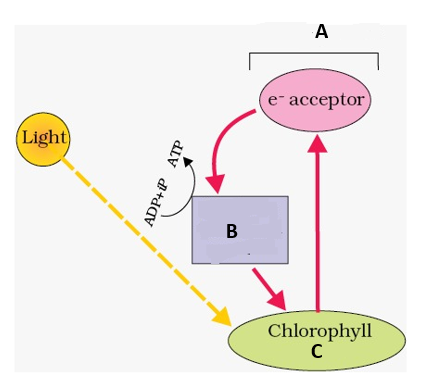
| 1. | A - Present in only grana lamellae. |
| 2. | B - involves downhill movement of electrons in terms of oxidation-reduction potential. |
| 3. | C - Absorbs 700 nm light. |
| 4. | The electrons return back to the reaction center. |
The process which makes a major difference between C3 and C4 plants is:
| 1. | glycolysis | 2. | Calvin cycle |
| 3. | photorespiration | 4. | respiration |
In plant cells, synthesis of ATP by the chemiosmotic
mechanism occurs during
1. Photosynthesis only.
2. Respiration only.
3. Both photosynthesis and respiration.
4. Photorespiration only.
Stroma lamella in plastid lacks
1. PS II and PS I.
2. PS II and NADP reductase.
3. PS I and NAD reductase.
4. PS II only.
Chemiosmosis (related with respiration, photosynthesis ETS) does not require
1. Membrane, a proton pump.
2. ATP.
3. A proton gradient.
4. ATPase.
If there are 12 molecules of CO2 to be fixed in photosynthesis, then how many turns of the Calvin cycle and how many molecules of glucose will be synthesized respectively?
1. 9 turns, 2 molecules.
2. 12 turns, 1 molecule.
3. 6 turns, 1 molecule.
4. 12 turns, 2 molecules.
The synthesis of one molecule of glucose during the Calvin cycle requires.
1. 12 molecules of ATP and 18 molecules of
2. 6 molecules of ATP and 12 molecules of
3. 18 molecules of ATP and 12 molecules of
4. 12 molecules of each of ATP and

© 2024 GoodEd Technologies Pvt. Ltd.