Select Chapter Topics:

 Q. No.
For the graph given below, it can be concluded that work done during the process shown will be-

1.
Zero
2.
Negative
3.
Positive
4.
Cannot be determined


Subtopic: First Law of Thermodynamics |
69%
Level 2: 60%+
Hints

Consider the following diagram for a reaction .
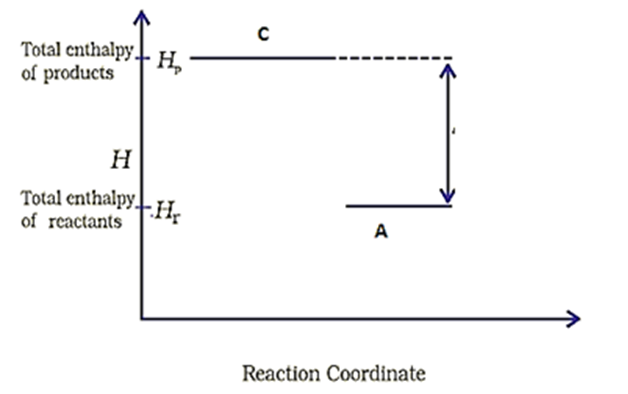
The nature of the reaction is-
1. Exothermic
2. Endothermic
3. Reaction at equilibrium
4. None of the above
Subtopic: Enthalpy & Internal energy |
84%
Level 1: 80%+
Hints
What is the nature of the reaction depicted in the given diagram for A→C?

| 1. | Exothermic | 2. | Endothermic |
| 3. | Reaction at equilibrium | 4. | None of these |
Subtopic: Enthalpy & Internal energy |
83%
Level 1: 80%+
Hints


The thermodynamic stability of NO(g) based on the above data is:
1. Less than NO2(g)
2. More than NO2(g)
3. Equal to NO2(g)
4. Insufficient data
Subtopic: Enthalpy & Internal energy |
71%
Level 2: 60%+
Hints
Select the correct option based on statements below:
| Assertion (A): | Work done in an irreversible isothermal process at constant volume is zero. |
| Reason (R): | Work is assigned a negative sign during expansion and is assigned a positive sign during compression. |
| 1. | Both (A) and (R) are true and (R) is the correct explanation of (A). |
| 2. | Both (A) and (R) are true but (R) is not the correct explanation of (A). |
| 3. | (A) is true but (R) is false. |
| 4. | Both (A) and (R) are false. |
Subtopic: First Law of Thermodynamics |
79%
Level 2: 60%+
Hints
Select the correct option based on statements below:
| Assertion (A): | Dissolution of sugar in water proceeds via an increase in entropy. |
| Reason (R): | Entropy decreases, when an egg is boiled hard. |
| 1. | Both (A) and (R) are True and (R) is the correct explanation of (A). |
| 2. | Both (A) and (R) are True but (R) is not the correct explanation of (A). |
| 3. | (A) is True but (R) is False. |
| 4. | Both (A) and (R) are False. |
Subtopic: Spontaneity & Entropy |
67%
Level 2: 60%+
Hints


Select the correct option based on the statements given below:
| Statement I. | Specific heat is an intensive property. |
| Statement II. | Heat capacity is an extensive property. |
| 1. | Statement I is correct; Statement II is correct. |
| 2. | Statement I is correct; Statement II is incorrect. |
| 3. | Statement I is incorrect; Statement II is correct. |
| 4. | Statement I is incorrect; Statement II is incorrect. |
Subtopic: Classification of System, Extensive & Intensive Properties |
Level 3: 35%-60%
Hints
Links
Subtopic: Gibbs Energy Change |
77%
Level 2: 60%+
Hints
Links
The standard enthalpy of the formation of CH3OH(l) from the following data is:
| \(\small{\mathrm{CH}_3 \mathrm{OH}_{(l)}+\frac{3}{2} \mathrm{O}_2(\mathrm{g}) \rightarrow \mathrm{CO}_2(\mathrm{g})+2 \mathrm{H}_2 \mathrm{O}_{(l)} \text {; }}\) \( \Delta_{\mathrm{r}} \mathrm{H}^{\circ}=-726 \mathrm{~kJ} \mathrm{~mol}{ }^{-1}\) |
| \(\small{\mathrm{C}(\mathrm{s})+\mathrm{O}_2(\mathrm{g}) \rightarrow \mathrm{CO}_2(\mathrm{g}) \text {; } }\) \(\Delta_{\mathrm{c}} \mathrm{H}^{\circ}=-393 \mathrm{~kJ} \mathrm{~mol}{ }^{-1}\) |
| \(\small{\mathrm{H}_{2(\mathrm{g})}+\frac{1}{2} \mathrm{O}_{2(\mathrm{g})} \rightarrow \mathrm{H}_2 \mathrm{O}_{(l)} \text {; } } \) \(\Delta_{\mathrm{f}} \mathrm{H}^{\circ}=-286 \mathrm{~kJ} \mathrm{~mol}^{-1}\) |
| 1. | −239 kJ mol−1 | 2. | +239 kJ mol−1 |
| 3. | −47 kJ mol−1 | 4. | +47 kJ mol−1 |
Subtopic: Thermochemistry |
64%
Level 2: 60%+
Hints


. The standard enthalpy of formation of gas in the above reaction would be:
| 1. | -92.4 J (mol)-1 | 2. | -46.2 kJ (mol)-1 |
| 3. | +46.2 J (mol)-1 | 4. | +92.4 kJ (mol)-1 |
Subtopic: Thermochemistry |
83%
Level 1: 80%+
Hints
Select Chapter Topics:

© 2026 GoodEd Technologies Pvt. Ltd.