
 Q. No.
The amount of elastic potential energy per unit volume (in SI unit) of a steel wire of length \(100~\text{cm}\) to stretch it by \(1~\text{mm}\) is:
(given: Young's modulus of the wire = \(Y=2.0\times 10^{11}~\text{N/m}^2\))
1. \(10^{11}~\text{J/m}^3\)
2. \(10^{17}~\text{J/m}^3\)
3. \(10^{7}~\text{J/m}^3\)
4. \(10^{5}~\text{J/m}^3\)


| 1. | zero | 2. | \(\frac{2W}{A}\) |
| 3. | \(\frac{W}{A}\) | 4. | \(\frac{W}{2A}\) |
| Assertion (A): | The stretching of a spring is determined by the shear modulus of the material of the spring. |
| Reason (R): | A coil spring of copper has more tensile strength than a steel spring of the same dimensions. |
| 1. | Both (A) and (R) are True and (R) is the correct explanation of (A). |
| 2. | Both (A) and (R) are True but (R) is not the correct explanation of (A). |
| 3. | (A) is False but (R) is True. |
| 4. | (A) is True but (R) is False. |


1. \(0.4~\text{mm}\)
2. \(40~\text{mm}\)
3. \(8~\text{mm}\)
4. \(4~\text{mm}\)
The figure given below shows the longitudinal stress vs longitudinal strain graph for a given material. Based on the given graph, Young's modulus of the material with the increase in strain will:

1. be variable.
2. first increase & then decrease.
3. first decrease & then increase.
4. remain constant.
The average depth of the Indian Ocean is about \(3000~\text m.\) The fractional compression \(\frac{\Delta V}{V},\) of water at the bottom of the ocean is?
(Given that the bulk modulus of water is \(2.2\times10^{9}~\text{Nm}^{-2}\) and \(g=10~\text{ms}^{-2}\))
1. \(1.36\times10^{-3}\)
2. \(2.36\times10^{-3}\)
3. \(1.36\times10^{-2}\)
4. \(2.36\times10^{-2}\)


A square lead slab of side \(50~\text{cm}\) and thickness \(10~\text{cm}\) is subject to a shearing force (on its narrow face) of \(9.0\times 10^{4}~\text{N}.\) The lower edge is riveted to the floor as shown in the figure below. How much will the upper edge be displaced? (Shear modulus of lead \(= 5.6\times 10^{9}~\text{Nm}^{-2}\))

| 1. | \(0.16~\text{mm}\) | 2. | \(1.8~\text{mm}\) |
| 3. | \(18~\text{mm}\) | 4. | \(16~\text{mm}\) |
In a human pyramid in a circus, the entire weight of the balanced group is supported by the legs of a performer who is lying on his back (as shown in the figure below). The combined mass of all the persons performing the act, and the tables, plaques, etc. involved is \(280~\text{kg}\). The mass of the performer lying on his back at the bottom of the pyramid is \(60~\text{kg}\). Each thighbone (femur) of this performer has a length of \(50~\text{cm}\) and an effective radius of \(2.0~\text{cm}\). The amount by which each thighbone gets compressed under the extra load is: (The Young’s modulus for bone is given by, \(Y = 9.4\times 10^9~\text{N/m}^{2}\))
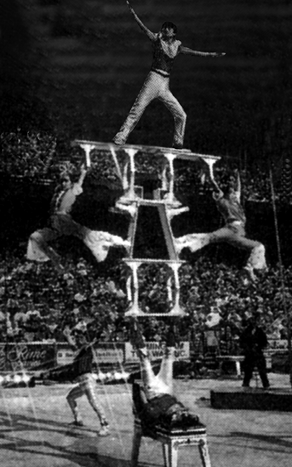
1. \(4.55\times 10^{-5}~\text{cm}\)
2. \(5.45\times 10^{-3}~\text{cm}\)
3. \(5.45\times 10^{-5}~\text{cm}\)
4. \(4.55\times 10^{-3}~\text{cm}\)
1. \(1.8\times 10^{2}~\text{N}\)
2. \(1.8~\text{N}\)
3. \(1.8\times 10^{3}~\text{N}\)
4. \(18\times 10^{3}~\text{N}\)


(Young’s modulus of structural steel is \(2.0\times 10^{11}~\text{Nm}^{-2}.)\)
1. \(3.18\times 10^{7}~\text{Nm}^{-2}~\text{and}~2.59~\text{mm}\)
2. \(3.18\times 10^{8}~\text{Nm}^{-2}~\text{and}~1.59~\text{m}\)
3. \(3.18\times 10^{8}~\text{Nm}^{-2}~\text{and}~1.59~\text{mm}\)
4. \(3.18\times 10^{7}~\text{Nm}^{-2}~\text{and}~2.59~\text{m}\)

© 2026 GoodEd Technologies Pvt. Ltd.