
 Q. No.
Figures (a) and (b) show the field lines of a positive and negative point charge respectively.
The signs of the potential difference
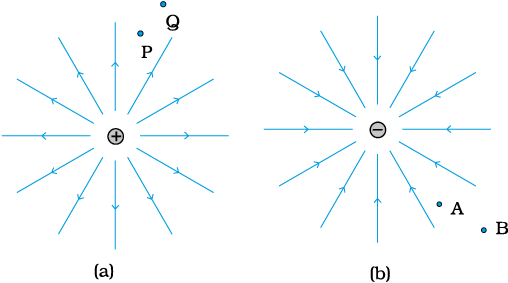


Figures (a) and (b) show the field lines of a positive and negative point charge respectively. The signs of the potential energy difference of a small negative charge between the points Q and P & A and B are respectively:
Figures (a) and (b) show the field lines of a positive and negative point charge respectively. The sign of the work done by the field in moving a small positive charge from Q to P and the sign of the work done by the external agency in moving a small negative charge from B to A, respectively, will be:


Figures (a) and (b) show the field lines of a positive and negative point charge respectively. The kinetic energy of a small negative charge in going from B to A:
1. decreases.
2. increases.
3. remains the same.
4. first increases and then decreases.
Four charges are arranged at the corners of a square ABCD of side d, as shown in the figure. The work required to put together this arrangement will be:
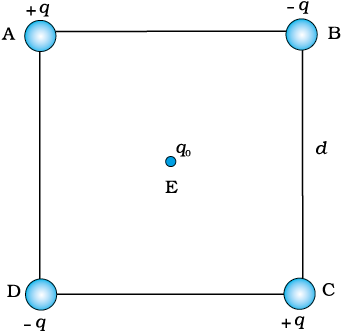
Four charges are arranged at the corners of a square \(ABCD\) of side \(d\), as shown in the figure. A charge \(q_0\) is brought from \(\infty\) to the centre \(E\) of the square, the four charges being held fixed at its corners. How much work is needed to do this?
1. \(\frac{-q^2}{4\pi\varepsilon_0 d}(4-\sqrt{2})\)
2. zero
3. \(\frac{-q^2}{4\pi\varepsilon_0 d}(4+\sqrt{2})\)
4. \(\frac{-q^2}{4\pi\varepsilon_0 d}(2+\sqrt{2})\)


The electrostatic potential energy of a system consisting of two charges 7 µC and –2 µC (and with no external field) placed at (–9 cm, 0, 0) and (9 cm, 0, 0) respectively is:
1. 0.2 J
2. -0.7 J
3. -0.2 J
4. 0.7 J
How much work is required to separate two charges 7 µC and –2 µC (and with no external field) placed at (–9 cm, 0, 0) and (9 cm, 0, 0) infinitely away from each other?
1. 0.2 J
2. -0.7 J
3. -0.2 J
4. 0.7 J
The electrostatic potential energy of a system consisting of two charges 7 µC and –2 µC (in an external electric field E = A(1/r2); A = 9 × 10⁵ C m–2) placed at (–9 cm, 0, 0) and (9 cm, 0, 0) respectively is:
1. 34 J
2. 49.3 J
3. 47 J
4. 43 J


A molecule of a substance has a permanent electric dipole moment of magnitude 10–29 C m. A mole of this substance is polarised (at low temperature) by applying a strong electrostatic field of magnitude 106 V m–1. The direction of the field is suddenly changed by an angle of . The heat released by the substance in aligning its dipoles along the new direction of the field is: (For simplicity, assume 100% polarisation of the sample).
1. 6 J
2. 8 J
3. 3 J
4. 4 J

© 2026 GoodEd Technologies Pvt. Ltd.