
With the decrease of current in the primary coil from \(2\) A to zero in \(0.01\) s, the emf generated in the secondary coil is \(1000~\text{V}\). The mutual inductance of the two coils is:
1. \(1.25\) H
2. \(2.50\) H
3. \(5.00\) H
4. \(10.00\) H
1. \(1.25\) H
2. \(2.50\) H
3. \(5.00\) H
4. \(10.00\) H


The coefficient of self induction of two inductor coils are 20 mH and 40 mH respectively. If the coils are connected in series so as to support each other and the resultant inductance is 80 mH then the value of mutual inductance between the coils will be:
1. 5 mH
2. 10 mH
3. 20 mH
4. 40 mH
A coil and a bulb are connected in series with a 12 volt direct current source. A soft iron core is now inserted in the coil. Then
1. The intensity of the bulb remains the same
2. The intensity of the bulb decreases
3. The intensity of the bulb increases
4. Nothing can be said


A uniform magnetic field B is directed out of the page. A metallic wire has the shape of a square frame and is placed in the field as shown. While the shape of the wire is steadily transformed into a circle in the same plane, the current in the frame:
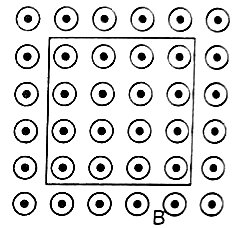
1. is directed clockwise
2. does not appear
3. is directed counter clockwise
4. is alternating
The dimension of the ratio of magnetic flux and the resistance is equal to that of:
1. induced emf
2. charge
3. inductance
4. current
Three identical coils A, B and C carrying currents are placed coaxially with their planes parallel to one another. A and C carry currents as shown. B is kept fixed, while A and C both are moved towards B with the same speed. Initially, B is equally seperated from A and C. The direction of the induced current in the coil B is :
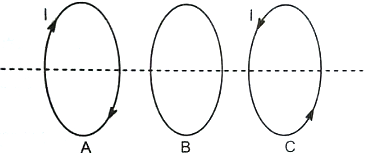
1. same as that in coil A
2. same as that in coil B
3. zero
4. none of the above


In the arrangement shown in given figure, current from A to B is increasing in magnitude. Induced current in the loop will:
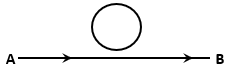
1. have clockwise direction
2. have anticlockwise direction
3. be zero
4. oscillate between clockwise and anticlockwise
Two identical coaxial circular loops carry a current \(i\) each circulating in the same direction. If the loops approach each other:
| 1. | the current in each will decrease |
| 2. | the current in each will increase |
| 3. | the current in each will remain the same |
| 4. | decrease |

A rectangular coil of wire rotates about an axis which is perpendicular to a uniform magnetic field at a steady rate. Consider the instant when the plane of the coil is parallel to the magnetic field lines. At that instant the induced electromotive force is :
1. minimum
2. maximum
3. zero
4. constant at all times


\(\mathrm A\) and \(\mathrm B\) are two metallic rings placed at opposite sides of an infinitely long straight conducting wire as shown. If current in the wire is slowly decreased, the direction of the induced current will be:

| 1. | clockwise in \(\mathrm A\) and anticlockwise in \(\mathrm B\). |
| 2. | anticlockwise in \(\mathrm A\) and clockwise in \(\mathrm B\). |
| 3. | clockwise in both \(\mathrm A\) and \(\mathrm B\). |
| 4. | anticlockwise in both \(\mathrm A\) and \(\mathrm B\). |

© 2026 GoodEd Technologies Pvt. Ltd.