
 Q. No.
The position-time graph for a particle moving along a straight line is shown in figure. The total distance travelled by it in time \(t=0\) to \(t=10\text{ s}\) is:

1. Zero
2. \(10\text{ m}\)
3. \(20\text{ m}\)
4. \(80\text{ m}\)


The position-time graph for a body moving along the straight line between O and A is shown in During its motion between O and A, how many times the body comes to rest?
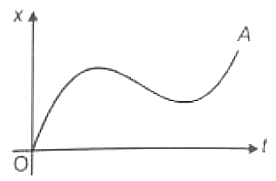
(1) Zero
(2) 1 time
(3) 2 times
(4) 3 times
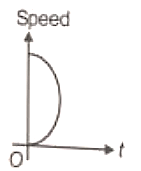
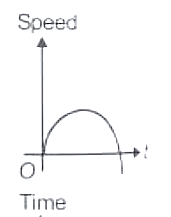
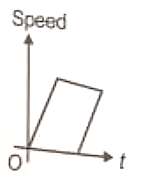
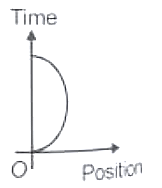
Which one of the following graph for a body moving along a straight line is possible?
(1) 
(2) 
(3) 
(4) 


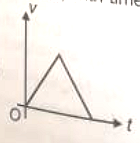
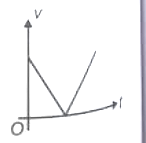
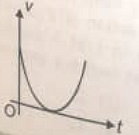
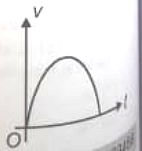
A body is projected vertically upward from ground. If we neglect the effect of air, then which one of te following is the best representation of variation of speed (v) with timw (t) ?
(1) 
(2) 
(3) 
(4) 
Which one of the following displacement-time graph represents two moving objects \(P\) and \(Q\) with zero relative velocity?
| 1. | 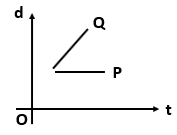 |
2. | 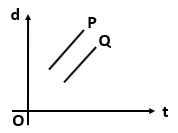 |
| 3. | 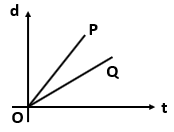 |
4. | 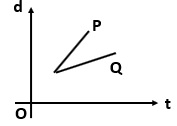 |
The displacement-time graph for two particles A and B is as follows. The ratio is
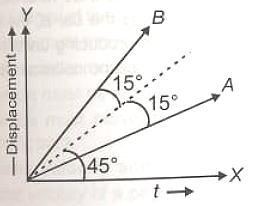
(1) 1: 2
(2) 1:
(3) : 1
(4) 1: 3


For the acceleration-time \((a-t)\) graph shown in figure, the change in velocity of particle from \(t=0\) to \(t=6~\text s\) is
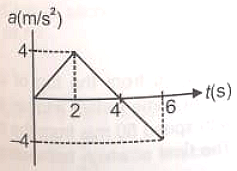

1. \(10~\text{m/s}\)
2. \(4~\text{m/s}\)
3. \(12~\text{m/s}\)
4. \(8~\text{m/s}\)
The velocity versus time graph of a body moving in a straight line is as shown in the figure below:

| 1. | The distance covered by the body in \(0\) to \(2~\text{s}\) is \(8~\text{m}\). |
| 2. | The acceleration of the body in \(0\) to \(2~\text{s}\) is \(4~\text{ms}^{-2}\). |
| 3. | The acceleration of the body in \(2\) to \(3~\text{s}\) is \(4~\text{ms}^{-2}\). |
| 4. | The distance moved by the body during \(0\) to \(3~\text{s}\) is \(6~\text{m}\). |
The acceleration-time graph for a particle is given in the figure. If it starts motion at \(t=0\), the distance travelled in \(3\) s will be:

1. \(4~\text{m}\)
2. \(2~\text{m}\)
3. \(0~\text{m}\)
4. \(6~\text{m}\)


Figure shows the position of a particle moving on the x-axis as a function of time
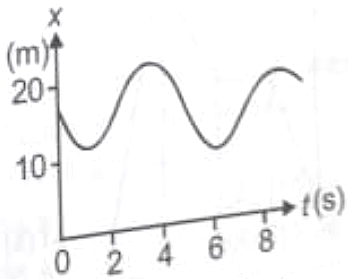
(1) The particle has come to rest 4 times
(2) The velocity at t = 8 s is negative
(3) The velocity remains positive for t = 2 s to t = 6 s
(4) The particle moves with a constant velocity

© 2026 GoodEd Technologies Pvt. Ltd.