
 Q. No.
The figure shows the graph of the x-coordinate of a particle moving along the x-axis as a function of time. Average velocity during t=0 to 6 s and instantaneous velocity at t=3 s respectively, will be:

1. 10 m/s, 0
2. 60 m/s, 0
3. 0, 0
4. 0, 10 m/s
2. 60 m/s, 0
3. 0, 0
4. 0, 10 m/s


Position-time graph for a particle is shown in the figure. Starting from t=0, at what time t, the average velocity is zero?
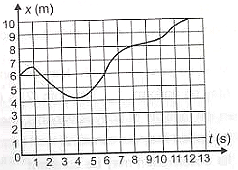
(1) 1 s
(2) 3 s
(3) 6 s
(4) 7 s
| 1. | zero velocity. | 2. | zero acceleration. |
| 3. | non-zero velocity. | 4. | non-zero acceleration. |


If a particle is moving along a straight line with increasing speed, then:
| 1. | its acceleration is negative. |
| 2. | its acceleration may be decreasing. |
| 3. | its acceleration is positive. |
| 4. | both (2) & (3) |
At any instant, the velocity and acceleration of a particle moving along a straight line are v and a. The speed of the particle is increasing if
(1) v>0, a>0
(2) v<0, a>0
(3) v>0, a<0
(4) v>0, a=0
If the magnitude of average speed and average velocity over a time interval are the same, then
(1) The particle must move with zero acceleration
(2) The particle must move with non-zero acceleration
(3) The particle must be at rest
(4) The particle must move in a straight line without turning back


If v is the velocity of a body moving along x-axis, then acceleration of body is
(1)
(2)
(3)
(4)
If a body is moving with constant speed, then its acceleration
1. Must be zero
2. May be variable
3. May be uniform
4. Both (2) & (3)
When the velocity of a body is variable, then:
| 1. | its speed may be constant |
| 2. | its acceleration may be constant |
| 3. | its average acceleration may be constant |
| 4. | all of the above |


An object is moving with variable speed, then
(1) Its velocity may be zero
(2) Its velocity must be variable
(3) Its acceleration may be zero
(4) Its velocity must be constant

© 2026 GoodEd Technologies Pvt. Ltd.