
 Q. No.
Let us assume that our galaxy consists of 2.5 × stars each of one solar mass. How long will a star at a distance of 50,000 ly from the galactic centre take to complete one revolution? (The diameter of the milky way is ly.)
1. 3.55 × 10⁸ years
2. 4.55 × 10⁸ years
3. 3.55 × 10⁷ years
4. 4.55 × 10⁷ years
1. 3.55 × 10⁸ years
2. 4.55 × 10⁸ years
3. 3.55 × 10⁷ years
4. 4.55 × 10⁷ years


The escape speed of a body from the Earth depends on:
| 1. | the mass of the body. |
| 2. | the location from where it is projected. |
| 3. | the direction of projection. |
| 4. | the height of the location from where the body is launched. |
A comet orbits the sun in a highly elliptical orbit. The comet has a constant:
1. linear speed
2. angular speed
3. angular momentum
4. kinetic energy


Which of the following symptoms is not likely to afflict an astronaut in space?
1. swollen feet
2. swollen face
3. headache
4. orientational problem
The gravitational intensity at the centre of a hemispherical shell of uniform mass density has the direction indicated by the arrow:
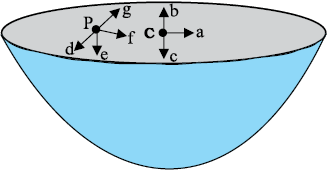
1. a, d
2. b, d
3. c, e
4. d, e
A rocket is fired from the earth towards the sun. At what distance from the earth’s centre is the gravitational force on the rocket zero?
Given, the mass of the sun = kg, the mass of the earth = kg, and orbital radius = m. Neglect the effect of other planets etc.
1. 2.59 × 10⁸ m
2. 3.10 × 10⁸ m
3. 4.07 × 10⁸ m
4. 2.23 × 10⁸ m


1. \(3 × {10}^{34}~\text{kg}\)
2. \(2 × 10^{30}~\text{kg}\)
3. \(1.5 × {10}^{28}~\text{kg}\)
4. \(1 × {10}^{35}~\text{kg}\)
A Saturn year is \(29.5\) times the Earth year. How far is Saturn from the sun if the Earth is \(1.5 \times 10^8 ~\text{km}\) away from the sun?
1. \( 2.01 × 10^{12}~\text{m}\)
2. \(3.86 × 10^{12}~\text{m}\)
3. \(1.43 × 10^{12}~\text{m}\)
4. \(4.19 × 10^{12}~\text{m}\)
A body weights \(63\) N on the surface of the earth. What is the gravitational force on it due to the earth at a height equal to half the radius of the earth?
1. \(98~\text N\)
2. \(35~\text N\)
3. \(63~\text N\)
4. \(28~\text N\)


Assuming the earth to be a sphere of uniform mass density, how much would a body weigh halfway down to the centre of the earth if it weighed \(250\) N on the surface?
| 1. | \(250\) N | 2. | \(125\) N |
| 3. | \(175\) N | 4. | \(145\) N |

© 2025 GoodEd Technologies Pvt. Ltd.