A particle of mass 10 kg is moving with a velocity of 10x m/s, where x is displacement. The work done by net force during the displacement of the particle from x = 4 m to x = 9 m is:

(1)  1250 J

(2)  1000

(3)  3500 J

(4)  2500 J

Subtopic:  Concept of Work |
 72%
Level 2: 60%+
Hints

premium feature crown icon
Unlock IMPORTANT QUESTION
This question was bookmarked by 5 NEET 2025 toppers during their NEETprep journey. Get Target Batch to see this question.
✨ Perfect for quick revision & accuracy boost
Buy Target Batch
Access all premium questions instantly

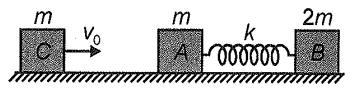
Two bodies A and B of mass m and 2m respectively are placed on a smooth floor as shown. They are connected by a spring of constant k. If a third body C of mass m moves with a velocity v0 along the line joining A and B and collides head-on elastically with A, then speed of A at the instant of maximum compression is
                              

1.  v0

2.  v02

3.  v04

4.  v03

Subtopic:  Collisions |
 51%
Level 3: 35%-60%
Hints

premium feature crown icon
Unlock IMPORTANT QUESTION
This question was bookmarked by 5 NEET 2025 toppers during their NEETprep journey. Get Target Batch to see this question.
✨ Perfect for quick revision & accuracy boost
Buy Target Batch
Access all premium questions instantly
A block of mass \(m\) is allowed to slide down a fixed smooth inclined plane of inclination \(\theta\) and slope length \(L\). What is the power developed by the force of gravity, when the block reaches the bottom?
1. \(\sqrt{2m^2L(g\sin\theta)^3}\)
2. \(\frac{2}{3}Lg^2\sin\theta\)
3. \(\sqrt{\frac{2}{3}m^2Lg^3}\)
4. \(mg\sqrt{2gL\sin\theta}\)

Subtopic:  Power |
 55%
Level 3: 35%-60%
Hints

advertisementadvertisement

Which of the following statement is correct regarding potential energy?

(1)  Change in potential energy depends upon reference point.

(2)  Potential energy does not depend upon reference point.

(3)  Potential energy can be defined for any field.

(4)  Change in potential energy of any particle is equal to work done by external force for moving the particle in equilibrium in a conservative field.

Subtopic:  Potential Energy: Relation with Force |
 65%
Level 2: 60%+
Hints

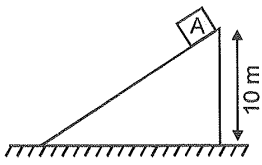
A body A of mass 10 kg at rest starts slipping from the top of the inclined plane of height 10 m as shown. If it reaches the ground at 10 m/s, then work done by friction is
                       

(1)  500 J

(2)  -500 J

(3)  1000 J

(4)  -1000 J

Subtopic:  Work Energy Theorem |
 75%
Level 2: 60%+
Hints

premium feature crown icon
Unlock IMPORTANT QUESTION
This question was bookmarked by 5 NEET 2025 toppers during their NEETprep journey. Get Target Batch to see this question.
✨ Perfect for quick revision & accuracy boost
Buy Target Batch
Access all premium questions instantly

A body is released from the top of an inclined smooth plane of inclination θ. It reaches the bottom with speed u. If the angle of inclination is doubled keeping the height unchanged, then the speed of the object on reaching on the ground is

(1)  u

(2)  2u

(3)  u2cosθ

(4)  u2sinθ

Subtopic:  Gravitational Potential Energy |
 59%
Level 3: 35%-60%
Hints

advertisementadvertisement

premium feature crown icon
Unlock IMPORTANT QUESTION
This question was bookmarked by 5 NEET 2025 toppers during their NEETprep journey. Get Target Batch to see this question.
✨ Perfect for quick revision & accuracy boost
Buy Target Batch
Access all premium questions instantly

Select the correct statement. Work is done by the internal forces on the system

(1)  maybe zero.

(2)  must be greater than zero.

(3)  must be less than zero.

(4)  must be zero.

Subtopic:  Concept of Work |
 53%
Level 3: 35%-60%
Hints

The potential energy of a particle of mass \(1\) kg free to move along the \(X\text-\)axis is given by \(U(x) = (3x^2-4x+6)~\text{J}\). The force acting on the particle at \(x=0\) will be:
1. \(2\hat i~\text{N}\)
2. \(-4\hat i~\text{N}\)
3. \(5\hat i~\text{N}\)
4. \(4\hat i~\text{N}\)
Subtopic:  Potential Energy: Relation with Force |
 64%
Level 2: 60%+
Hints
Links

premium feature crown icon
Unlock IMPORTANT QUESTION
This question was bookmarked by 5 NEET 2025 toppers during their NEETprep journey. Get Target Batch to see this question.
✨ Perfect for quick revision & accuracy boost
Buy Target Batch
Access all premium questions instantly

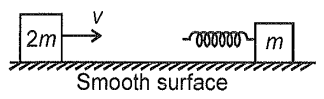
A block of mass \(m\) is attached with a spring of spring constant \(k\) as shown in the figure. Another block of mass \(2m\) moving with speed \(v\) hits the spring. Speed of blocks at the instant of maximum compression of spring is:
                            
1. \(\dfrac{v}{3}\)

2. \(\dfrac{v}{2}\)

3. \(\dfrac{2v}{3}\)

4. \(\dfrac{3v}{2}\)

Subtopic:  Collisions |
 76%
Level 2: 60%+
Hints

advertisementadvertisement

The potential energy of a particle of mass m varies as U=ax2+by. The magnitude of the acceleration of the particle at (0, 3) is (symbols have their usual meaning)

1.  bm

2.  3bm

3.  bm

4.  Zero

Subtopic:  Potential Energy: Relation with Force |
 66%
Level 2: 60%+
Hints
