
 Q. No.
A bulb is rated at \(100\) V, \(100\) W, and is treated as a resistor. The inductance of an inductor (choke coil) that should be connected in series with the bulb to operate the bulb at its rated power with the help of an AC source of \(200\) V and \(50\) Hz is:
1. \(\dfrac{\pi }{\sqrt{3}}~\text{H}\)
2. \(100~\text{H}\)
3. \(\dfrac{\sqrt{2}}{\pi }~\text{H}\)
4. \(\dfrac{\sqrt{3}}{\pi }~\text{H}\)


What is the phase difference between potential difference across the inductor and potential difference across the capacitor in a series LCR circuit?
1. Zero
What is the reading of the A.C voltmeter in the network as shown in the figure?
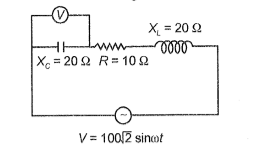
1. zero
2. 100 V
3. 200 V
4. 400 v


When an alternating voltage is given as; \(E = (6 \sin\omega t - 2 \cos \omega t)~\text V,\) what is its RMS value?
1. \(4 \sqrt 2 ~\text V\)
2. \(2 \sqrt 5 ~\text V\)
3. \(2 \sqrt 3 ~\text V\)
4. \(4 ~\text V\)
An LC circuit contains an inductor (L=25 mH) and a capacitor (C=25 mF) with an initial charge of Q0. At what time will the circuit have an equal amount of electrical and magnetic energy?
4. All of these
In which of the following circuits can the power factor be zero?
1. LC circuit
2. LCR circuit
3. Purely resistive circuit
4. Both (1) & (2)


In the given circuit, switch S is closed at t=0. After a long time, the iron rod is withdrawn from the inductor L. Then, the bulb
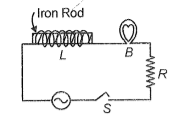
1. Glow with the same brightness
2. Glows more brightly
3. Gets dimmer
4. Stops glowing
LCR series circuit is connected with an alternating emf source. If the peak current and voltage are respectively then at resonance the value of wattless current is
The value of quality factor ( Q-value) of the series resonant circuit with inductance L = 2.0 H, capacitance C= 32 and resistance R = 10 , is
1. 25
2. 250
3. 0.25
4. 2.5


Given below are two statements:
| Statement I: | In an LCR circuit, the total energy stored is constant at resonance. |
| Statement II: | Resistance of the LCR circuit doesn't affect the total energy stored in the circuit at resonance. |
| 1. | Statement I is false but Statement II is true. |
| 2. | Both Statement I and Statement II are true. |
| 3. | Both Statement I and Statement II are false. |
| 4. | Statement I is true but Statement II is false. |

© 2026 GoodEd Technologies Pvt. Ltd.