 Q. No.
An incompressible fluid flows steadily through a cylindrical pipe which has radius \(2r\) at point \(A\) and radius \(r\) at \(B\) further along the flow direction. If the velocity at point \(A\) is \(v,\) its velocity at point \(B\) is:
1. \(2v\)
2. \(v\)
3. \(v/2\)
4. \(4v\)
1. \(2v\)
2. \(v\)
3. \(v/2\)
4. \(4v\)


A homogeneous solid cylinder of length L(L<H/2) . Cross-sectional area A/5 is immersed such that it floats with its axis vertical at the liquid-liquid interface with length L/4 in the denser liquid as shown in the fig. The lower density liquid is open to atmosphere having pressure . Then density D of solid is given by

1.
2.
3.
4.
A block of ice floats on a liquid of density 1.2 in a beaker. The level of liquid when ice completely melts-
1. Remains same
2. Rises
3. Lowers
4. (1), (2) or (3)


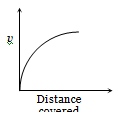
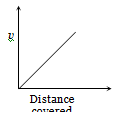
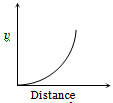
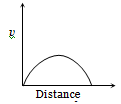
A lead shot of 1mm diameter falls through a long column of glycerine. The variation of its velocity v with distance covered is represented by
1. 
2. 
3. 
4. 
The surface tension of liquid is 0.5 N/m. If a film is held on a ring of area 0.02 , its surface energy is
1.
2.
3.
4.
A film of water is formed between two straight parallel wires of length 10cm each separated by 0.5 cm. If their separation is increased by 1 mm while still maintaining their parallelism, how much work will have to be done (Surface tension of water =)
1.
2.
3.
4.


A drop of mercury of radius 2 mm is split into 8 identical droplets. Find the increase in surface energy. (Surface tension of mercury is )
1.
2.
3.
4.
Two small drops of mercury, each of radius r, coalesce to form a single large drop. The ratio of the total surface energies before and after the change is
1. 2.
3. 2:1 4. 1:2
When a large bubble rises from the bottom of a lake to the surface, its radius doubles. If atmospheric pressure is equal to that of column of water height H, then the depth of lake is
1. H
2. 2H
3. 7H
4. 8H


If pressure at half the depth of a lake is equal to 2/3rd the pressure at the bottom of the lake, then the depth of the lake is:
| 1. | 10 m | 2. | 20 m |
| 3. | 60 m | 4. | 30 m |

© 2026 GoodEd Technologies Pvt. Ltd.