
 Q. No.
A solid cylinder of mass 2 kg and radius 50 cm rolls up an inclined plane of angle of inclination . The centre of mass of the cylinder has a speed of 4 m/s. The distance travelled by the cylinder on the inclined surface will be
1.
2.2 m
2.
1.6 m
3.
1.2 m
4.
2.4 m


| 1. | \( \dfrac{v_0}{n} ~\text{rad} / \text{s}^2\) | 2. | \( \dfrac{v_0^2}{2 \pi {nr}^2}~ \text{rad} / \text{s}^2 \) |
| 3. | \( \dfrac{v_0^2}{4 \pi {n}{r}^2}~ \text{rad} / \text{s}^2 \) | 4. | \( \dfrac{v_0^2}{4 \pi {nr}} ~\text{rad} / \text{s}^2 \) |
Two balls of mass M = 9 g and m = 3 g are attached by massless threads AO and OB. The length AB is 1 m. They are set in rotational motion in a horizontal plane about a vertical axis at O with constant angular velocity . The ratio of length OB and AO for which the tension in threads are same will be-
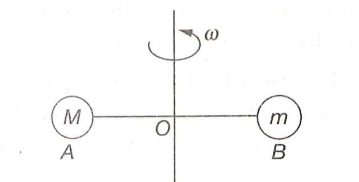
(1) 1
(2) 2
(3) 3
(4) 4


Internal forces cannot change:
(1) the kinetic energy of a system.
(2) the mechanical energy of a system.
(3) the momentum of a system.
(4) all of these
The masses are connected to the two ends of a compressed spring. Now, when the masses are released on a smooth surface, they will move away with
(1) the same magnitude of the force.
(2) the equal magnitude of linear momentum.
(3) the greater kinetic energy of the first body than that of the second body.
(4) All of these
Four masses are joined to light circular frames as shown in the figure. The radius of gyration of this system about an axis passing through the center of the circular frame and perpendicular to its plane would be:
(where '\(a\)' is the radius of the circle)

1. \(\frac{a}{\sqrt{2}}\)
2. \(\frac{a}{{2}}\)
3. \(a\)
4. \(2a\)


A disc of mass \(M\) and radius \(R\) starts falling down as shown in the figure. The string unwinds without slipping on the disc. The instantaneous power developed by the tension is:
1. \((T\times R \omega)\)
2. \((T\times R \omega)/2\)
3. \(2(T\times R \omega)\)
4. zero

The rotational analouge of equation, \(F=\dfrac{mdv}{dt} \) is:
| 1. | \(\tau=\dfrac{dL}{dt}\) | 2. | \(\tau=I \dfrac{d\omega}{dt} \) |
| 3. | \(\tau=I \dfrac{dI}{dt}\omega \) | 4. | \(\tau=I\dfrac{d\omega}{dt}+\frac{dI}{dt}\omega \) |
When a projectile of mass 2 kg is projected from the top of a tower of height 20 m with velocity 10 m/s in the horizontal direction, then angular momentum about the lowermost point of the tower when it touches the ground is:
(1) 600 kg
(2) 400 kg
(3) 800 kg
(4) Zero


The angular displacement() of the blades of
a ceiling fan, when the fan is switched on at
t = 0, is shown in figure. The average angular
velocity of the fan blades during the first 8
seconds will be

1. 40 rad/s
2. 20 rad/s
3.10 rad/s
4. 5 rad/s

© 2026 GoodEd Technologies Pvt. Ltd.