
 Q. No.
A ball of mass m moving with a speed u undergoes a head-on elastic collision with a ball of mass nm initially at rest. The fraction of initial energy transferred to the heavier ball is
(1)
(2)
(3)
(4)


1. \(\frac{v^2_0}{2g}\)
2. \(\frac{v^2_0}{4g}\)
3. \(\frac{v^2_0}{6g}\)
4. \(\frac{v^2_0}{8g}\)
An object flying in the air with velocity \((20 \hat{i}+25 \hat{j}-12 \hat{k})\) suddenly breaks into two pieces whose masses are in the ratio of \(1:5.\) The smaller mass flies off with a velocity \((100 \hat{i}+35 \hat{j}+8 \hat{k})\). The velocity of the larger piece will be:
1. \( 4 \hat{i}+23 \hat{j}-16 \hat{k}\)
2. \( -100 \hat{i}-35 \hat{j}-8 \hat{k} \)
3. \( 20 \hat{i}+15 \hat{j}-80 \hat{k} \)
4. \( -20 \hat{i}-15 \hat{j}-80 \hat{k}\)


A particle of mass \(5m\) at rest suddenly breaks on its own into three fragments. Two fragments of mass \(m\) each move along mutually perpendicular directions with speed \(v\) each. The energy released during the process is:
| 1. | \(\dfrac{3}{5}mv^2\) | 2. | \(\dfrac{5}{3}mv^2\) |
| 3. | \(\dfrac{3}{2}mv^2\) | 4. | \(\dfrac{4}{3}mv^2\) |
An object of mass \(500~\text g\) initially at rest is acted upon by a variable force whose \(x\)-component varies with \(x\) in the manner shown. The velocities of the object at the points \(x=8~\text m\) and \(x=12~\text m\) would have the respective values of nearly:

| 1. | \(18~\text {m/s}\) and \(22.4~\text {m/s}\) | 2. | \(23~\text {m/s}\) and \(22.4~\text {m/s}\) |
| 3. | \(23~\text {m/s}\) and \(20.6~\text {m/s}\) | 4. | \(18~\text {m/s}\) and \(20.6~\text {m/s}\) |
A body of mass moving with uniform velocity of 40 m/s collides with another mass at rest and then the two together begin to move with uniform velocity of 30 m/s. The ratio of their masses is
(1) 0.75
(2) 1.33
(3) 3.0
(4) 4.0


1. \(\frac{1}{5}\left(8\hat i +7\hat j-3\hat k\right)\)
2. \(\frac{1}{5}\left(-4\hat i +\hat j-3\hat k\right)\)
3. \(\frac{1}{5}\left(8\hat i +\hat j-\hat k\right)\)
4. \(\frac{1}{5}\left(-4\hat i +7\hat j-3\hat k\right)\)
A body of mass 5 kg is moving with a velocity of 10 m/s. Now a force that delivers a constant power of 75 watts is applied to it for 10 s in the same direction. The velocity of the body after 10 s will be
1.
2. 20 m/s
3. 40 m/s
4. m/s
A mass of 4kg falls from a height h on the pan. Initially, the spring is in its natural length and mass of spring and pan are negligible. Spring constant of the spring is 1000 N/m. The mass compresses the spring by 0.5 m. Then the height 'h' is
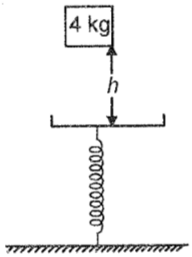
1. 2.00 m
2. 1.56 m
3. 4.0 m
4. 2.625 m


Human heartbeats 72 times per minute. It pumps 1 cc blood in each pulse under the pressure of The power of the heart is
1. 0.2 watt
2. 0.02 watt
3. 0.024 watt
4. watt

© 2026 GoodEd Technologies Pvt. Ltd.