
 Q. No.
For a gas, if the ratio of specific heats at constant pressure and constant volume is , then the value of degree of freedom is
(1)
(2)
(3)
(4)


The value \(\gamma = \frac{C_P}{C_V}\) for hydrogen, helium, and another ideal diatomic gas \(X\) (whose molecules are not rigid but have an additional vibrational mode), are respectively equal to:
| 1. | \(\dfrac{7}{5}, \dfrac{5}{3}, \dfrac{9}{7}\) | 2. | \(\dfrac{5}{3}, \dfrac{7}{5}, \dfrac{9}{7}\) |
| 3. | \(\dfrac{5}{3}, \dfrac{7}{5}, \dfrac{7}{5}\) | 4. | \(\dfrac{7}{5}, \dfrac{5}{3}, \dfrac{7}{5}\) |


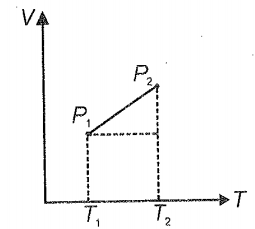
How does the temperature change when the state of an ideal gas is changed according to the process shown in the figure?

| 1. | temperature increases continuously. |
| 2. | temperature decreases continuously. |
| 3. | temperature first increases and then decreases. |
| 4. | temperature first decreases and then increases. |
Sorry!! currently, the explanation for the question is not provided. If you need further help, please email at support@neetprep.com with subject: Explanation Missing for Question Id: 160063
When the gas in an open container is heated, the mean free path:
1. Increases
2. Decreases
3. Remains the same
4. Any of the above depending on the molar mass


Maxwell's speed distribution graph is drawn as shown below. The most probable speed of the gas molecules is:
1. 4 km/s

2. Between 3 km/s and 1 km/s
3. Any value between 2 km/s and 6 km/s
4. More than 4 km/s
A closed container having an ideal gas is heated gradually to increase the temperature by 20% The mean free path will become/remain:
1. 20% more
2. Same
3. 20% less
4. 33% less
| 1. | \(3:1\) | 2. | \(9:1\) |
| 3. | \(1:1\) | 4. | \(1:4\) |


An increase in the temperature of a gas-filled container would lead to:
| 1. | decrease in intermolecular distance. |
| 2. | increase in its mass. |
| 3. | increase in its kinetic energy. |
| 4. | decrease in its pressure. |

© 2026 GoodEd Technologies Pvt. Ltd.