An electric current can be induced in a coil by flux change produced by another coil in its vicinity or flux change produced by the same coil. These two situations are described separately in the next two sub-sections. However, in both the cases, the flux through a coil is proportional to the current. That is, ΦB α I.
Further, if the geometry of the coil does not vary with time then,
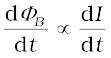
For a closely wound coil of N turns, the same magnetic flux is linked with all the turns. When the flux ΦB through the coil changes, each turn contributes to the induced emf. Therefore, a term called flux linkage is used which is equal to NΦB for a closely wound coil and in such a case
The constant of proportionality, in this relation, is called inductance. We shall see that inductance depends only on the geometry of the coil and intrinsic material properties. This aspect is akin to capacitance which for a parallel plate capacitor depends on the plate area and plate separation (geometry) and the dielectric constant K of the intervening medium (intrinsic material property).
Inductance is a scalar quantity. It has the dimensions of [M L2 T–2 A–2] given by the dimensions of flux divided by the dimensions of current. The SI unit of inductance is henry and is denoted by H. It is named in honour of Joseph Henry who discovered electromagnetic induction in USA, independently of Faraday in England.
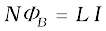
In the previous sub-section, we considered the flux in one solenoid due to the current in the other. It is also possible that emf is induced in a single isolated coil due to change of flux through the coil by means of varying the current through the same coil. This phenomenon is called self-induction. In this case, flux linkage through a coil of N turns is proportional to the current through the coil and is expressed as

 (6.15)
where constant of proportionality L is called self-inductance of the coil. It is also called the coefficient of self-induction of the coil. When the current is varied, the flux linked with the coil also changes and an emf is induced in the coil. Using Eq. (6.15), the induced emf is given by
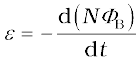
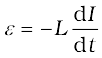 (6.16)
Thus, the self-induced emf always opposes any change (increase or decrease) of current in the coil.
It is possible to calculate the self-inductance for circuits with simple geometries. Let us calculate the self-inductance of a long solenoid of cross-sectional area A and length l, having n turns per unit length. The magnetic field due to a current I flowing in the solenoid is B = µ0n I (neglecting edge effects, as before). The total flux linked with the solenoid is

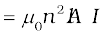
where nl is the total number of turns. Thus, the self-inductance is,

 (6.17)
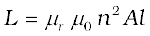
If we fill the inside of the solenoid with a material of relative permeability µr (for example soft iron, which has a high value of relative permeability), then,
 (6.18)
The self-inductance of the coil depends on its geometry and on the permeability of the medium.
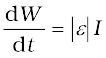
The self-induced emf is also called the back emf as it opposes any change in the current in a circuit. Physically, the self-inductance plays the role of inertia. It is the electromagnetic analogue of mass in mechanics. So, work needs to be done against the back emf (ε) in establishing the current. This work done is stored as magnetic potential energy. For the current I at an instant in a circuit, the rate of work done is
If we ignore the resistive losses and consider only inductive effect, then using Eq. (6.16),
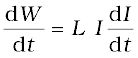
Total amount of work done in establishing the current I is
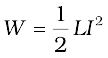
Thus, the energy required to build up the current I is,
 (6.19)
This expression reminds us of mv2/2 for the (mechanical) kinetic energy of a particle of mass m, and shows that L is analogous to m (i.e., L is electrical inertia and opposes growth and decay of current in the circuit).
Consider the general case of currents flowing simultaneously in two nearby coils. The flux linked with one coil will be the sum of two fluxes which exist independently. Equation (6.9) would be modified into
where M11 represents inductance due to the same coil.
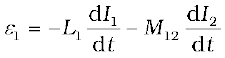
Therefore, using Faraday’s law,
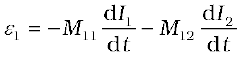
M11 is the self-inductance and is written as L1. Therefore,
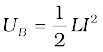
Example 6.10 (a) Obtain the expression for the magnetic energy stored in a solenoid in terms of magnetic field B, area A and length l of the solenoid. (b) How does this magnetic energy compare with the electrostatic energy stored in a capacitor?
Solution
(a) From Eq. (6.19), the magnetic energy is
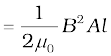
(b) The magnetic energy per unit volume is,
 (where V is volume that contains flux)

 (6.20)
We have already obtained the relation for the electrostatic energy stored per unit volume in a parallel plate capacitor (refer to Chapter 2, Eq. 2.77),
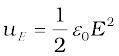 (2.77)
In both the cases energy is proportional to the square of the field strength. Equations (6.20) and (2.77) have been derived for special cases: a solenoid and a parallel plate capacitor, respectively. But they are general and valid for any region of space in which a magnetic field or/and an electric field exist.

© 2026 GoodEd Technologies Pvt. Ltd.