In Section 6.5, we discussed qualitatively that Lenz’s law is consistent with the law of conservation of energy. Now we shall explore this aspect further with a concrete example.
Let r be the resistance of movable arm PQ of the rectangular conductor shown in Fig. 6.10. We assume that the remaining arms QR, RS and SP have negligible resistances compared to r. Thus, the overall resistance of the rectangular loop is r and this does not change as PQ is moved. The current I in the loop is,

=  (6.7)
(6.7)
On account of the presence of the magnetic field, there will be a force on the arm PQ. This force I (l × B), is directed outwards in the direction opposite to the velocity of the rod. The magnitude of this force is,
F = I l B = 
where we have used Eq. (6.7). Note that this force arises due to drift velocity of charges (responsible for current) along the rod and the consequent Lorentz force acting on them.
Alternatively, the arm PQ is being pushed with a constant speed v, the power required to do this is,

= (6.8)
(6.8)
The agent that does this work is mechanical. Where does this mechanical energy go? The answer is: it is dissipated as Joule heat, and is given by


which is identical to Eq. (6.8).
Thus, mechanical energy which was needed to move the arm PQ is converted into electrical energy (the induced emf) and then to thermal energy.
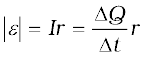
There is an interesting relationship between the charge flow through the circuit and the change in the magnetic flux. From Faraday’s law, we have learnt that the magnitude of the induced emf is,

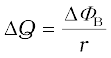
However,
Thus,
Example 6.8 Refer to Fig. 6.12(a). The arm PQ of the rectangular conductor is moved from x = 0, outwards. The uniform magnetic field is perpendicular to the plane and extends from x = 0 to x = b and is zero for x > b. Only the arm PQ possesses substantial resistance r. Consider the situation when the arm PQ is pulled outwards from x = 0 to x = 2b, and is then moved back to x = 0 with constant speed v. Obtain expressions for the flux, the induced emf, the force necessary to pull the arm and the power dissipated as Joule heat. Sketch the variation of these quantities with distance.
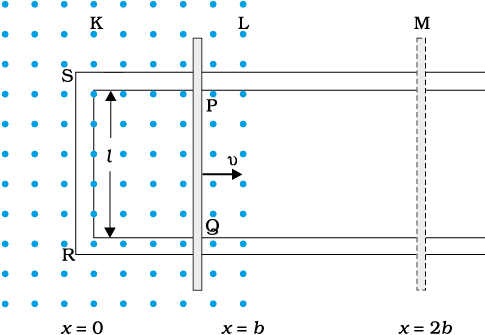
(a)
Figure 6.12
Solution
Let us first consider the forward motion from x = 0 to x = 2b
The flux ΦB linked with the circuit SPQR is


The induced emf is,



When the induced emf is non-zero, the current I is (in magnitude)

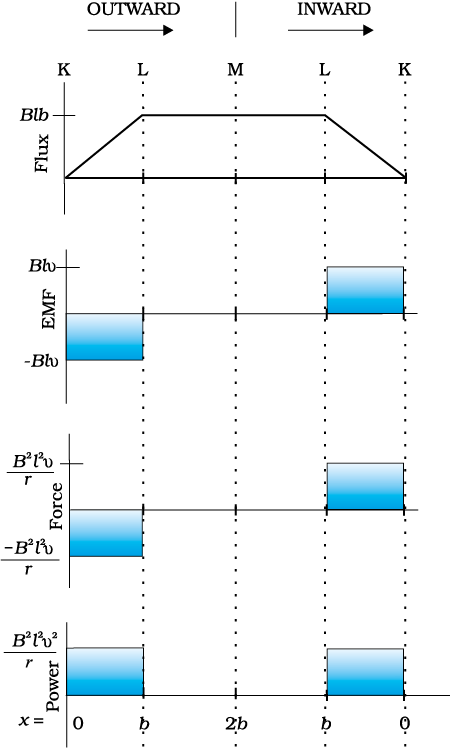
(b)
Figure 6.12
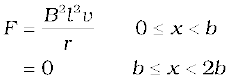
The force required to keep the arm PQ in constant motion is I lB. Its direction is to the left. In magnitude
The Joule heating loss is

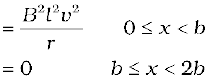
One obtains similar expressions for the inward motion from x = 2b to x = 0. One can appreciate the whole process by examining the sketch of various quantities displayed in Fig. 6.12(b).

© 2026 GoodEd Technologies Pvt. Ltd.