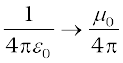
Comparison of Eqs. (5.2), (5.3) and (5.6) with the corresponding equations for electric dipole (Chapter 1), suggests that magnetic field at large distances due to a bar magnet of magnetic moment m can be obtained from the equation for electric field due to an electric dipole of dipole moment p, by making the following replacements:
 , ,
, , 
In particular, we can write down the equatorial field (BE) of a bar magnet at a distance r, for r >> l, where l is the size of the magnet:
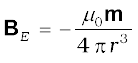 (5.7)
(5.7)
Likewise, the axial field (BA) of a bar magnet for r >> l is:
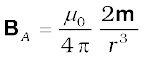 (5.8)
(5.8)
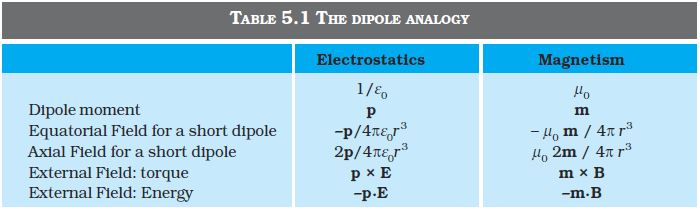
Equation (5.8) is just Eq. (5.2) in the vector form. Table 5.1 summarises the analogy between electric and magnetic dipoles.
Example 5.4 What is the magnitude of the equatorial and axial fields due to a bar magnet of length 5.0 cm at a distance of 50 cm from its mid-point? The magnetic moment of the bar magnet is 0.40 A m2, the same as in Example 5.2.
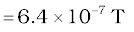
Solution From Eq. (5.7)
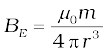
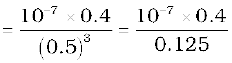
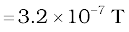
From Eq. (5.8),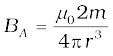
Example 5.5 Figure 5.5 shows a small magnetised needle P placed at a point O. The arrow shows the direction of its magnetic moment. The other arrows show different positions (and orientations of the magnetic moment) of another identical magnetised needle Q.
(a) In which configuration the system is not in equilibrium?
(b) In which configuration is the system in (i) stable, and (ii) unstable equilibrium?
(c) Which configuration corresponds to the lowest potential energy among all the configurations shown?
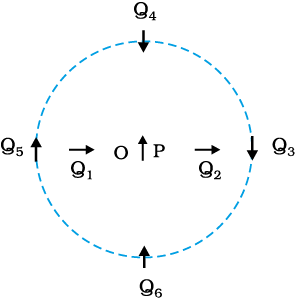
Figure 5.5
Solution
Potential energy of the configuration arises due to the potential energy of one dipole (say, Q) in the magnetic field due to other (P). Use the result that the field due to P is given by the expression [Eqs. (5.7) and (5.8)]:
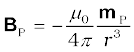 (on the normal bisector)
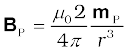 (on the axis)
where mP is the magnetic moment of the dipole P.
Equilibrium is stable when mQ is parallel to BP, and unstable when it is anti-parallel to BP.
For instance for the configuration Q3 for which Q is along the perpendicular bisector of the dipole P, the magnetic moment of Q is parallel to the magnetic field at the position 3. Hence Q3 is stable.
Thus,
(a) PQ1 and PQ2
(b) (i) PQ3, PQ6 (stable); (ii) PQ5, PQ4 (unstable)
(c) PQ6

© 2026 GoodEd Technologies Pvt. Ltd.