Alkyl halides are colourless when pure. However, bromides and iodides develop colour when exposed to light. Many volatile halogen compounds have sweet smell.
Melting and boiling points
Methyl chloride, methyl bromide, ethyl chloride and some chlorofluoromethanes are gases at room temperature. Higher members are liquids or solids. As we have already learnt, molecules of organic halogen compounds are generally polar. Due to greater polarity as well as higher molecular mass as compared to the parent hydrocarbon, the intermolecular forces of attraction (dipole-dipole and van der Waals) are stronger in the halogen derivatives. That is why the boiling points of chlorides, bromides and iodides are considerably higher than those of the hydrocarbons of comparable molecular mass.
The attractions get stronger as the molecules get bigger in size and have more electrons. The pattern of variation of boiling points of different halides is depicted in Fig. 10.1. For the same alkyl group, the boiling points of alkyl halides decrease in the order: RI> RBr> RCl> RF. This is because with the increase in size and mass of halogen atom, the magnitude of van der Waal forces increases.
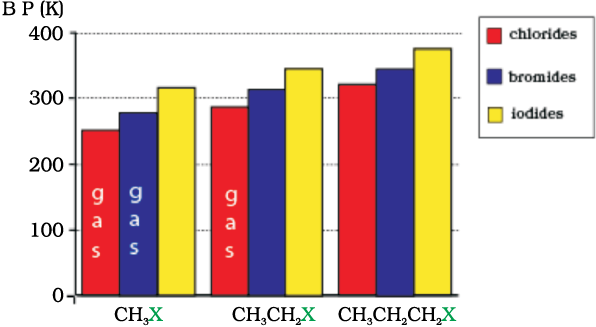
Table 10.3: Density of Some Haloalkanes
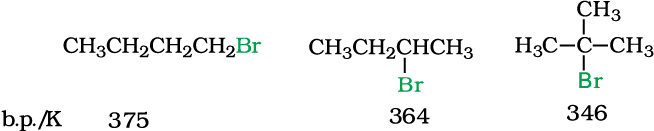
The boiling points of isomeric haloalkanes decrease with increase in branching (Unit 12, Class XI). For example, 2-bromo-2-methylpropane has the lowest boiling point among the three isomers.
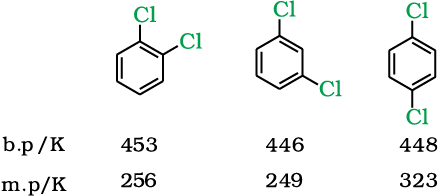
Boiling points of isomeric dihalobenzenes are very nearly the same. However, the para-isomers are high melting as compared to their ortho- and meta-isomers. It is due to symmetry of para-isomers that fits in crystal lattice better as compared to ortho- and meta-isomers.
Density
Bromo, iodo and polychloro derivatives of hydrocarbons are heavier than water. The density increases with increase in number of carbon atoms, halogen atoms and atomic mass of the halogen atoms (Table 10.3).

Solubility
The haloalkanes are very slightly soluble in water. In order to dissolve haloalkane in water, energy is required to overcome the attractions between the haloalkane molecules and break the hydrogen bonds between water molecules. Less energy is released when new attractions are set up between the haloalkane and the water molecules as these are not as strong as the original hydrogen bonds in water. As a result, the solubility of haloalkanes in water is low. However, haloalkanes tend to dissolve in organic solvents because the new intermolecular attractions between haloalkanes and solvent molecules have much the same strength as the ones being broken in the separate haloalkane and solvent molecules.
Intext Questions
10.6 Arrange each set of compounds in order of increasing boiling points.
(i) Bromomethane, Bromoform, Chloromethane, Dibromomethane.
(ii) 1-Chloropropane, Isopropyl chloride, 1-Chlorobutane.

© 2026 GoodEd Technologies Pvt. Ltd.