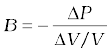
In a longitudinal wave, the constituents of the medium oscillate forward and backward in the direction of propagation of the wave. We have already seen that the sound waves travel in the form of compressions and rarefactions of small volume elements of air. The elastic property that determines the stress under compressional strain is the bulk modulus of the medium defined by (see Chapter 9)
 (15.16)
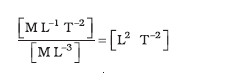
Here, the change in pressure ∆P produces a volumetric strain . B has the same dimension as pressure and given in SI units in terms of pascal (Pa). The inertial property relevant for the propagation of wave is the mass density ρ, with dimensions [ML–3]. Simple inspection reveals that quantity B/ρ has the relevant dimension:
 (15.17)
Thus, if B and are considered to be the only relevant physical quantities,
v = C (15.18)
where, as before, C is the undetermined constant from dimensional analysis. The exact derivation shows that C=1. Thus, the general formula for longitudinal waves in a medium is:
v = (15.19)
For a linear medium, like a solid bar, the lateral expansion of the bar is negligible and we may consider it to be only under longitudinal strain. In that case, the relevant modulus of elasticity is Young’s modulus, which has the same dimension as the Bulk modulus. Dimensional analysis for this case is the same as before and yields a relation like Eq. (15.18), with an undetermined C, which the exact derivation shows to be unity. Thus, the speed of longitudinal waves in a solid bar is given by
v = (15.20)
where Y is the Young’s modulus of the material of the bar. Table 15.1 gives the speed of sound in some media.
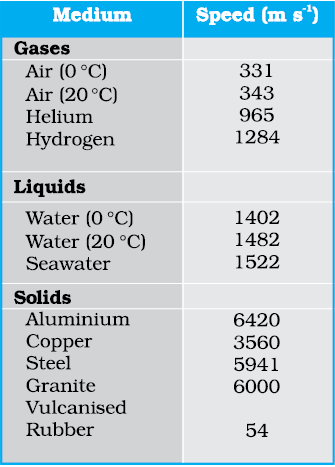
Liquids and solids generally have higher speed of sound than gases. [Note for solids, the speed being referred to is the speed of longitudinal waves in the solid]. This happens because they are much more difficult to compress than gases and so have much higher values of bulk modulus. Now, see Eq. (15.19). Solids and liquids have higher mass densities ( ) than gases. But the corresponding increase in both the modulus (B) of solids and liquids is much higher. This is the reason why the sound waves travel faster in solids and liquids.
We can estimate the speed of sound in a gas in the ideal gas approximation. For an ideal gas, the pressure P, volume V and temperature T are related by (see Chapter 11).
PV = NkBT (15.21)
where N is the number of molecules in volume V, kB is the Boltzmann constant and T the temperature of the gas (in Kelvin). Therefore, for an isothermal change it follows from Eq.(15.21) that
V∆P + P∆V = 0
or 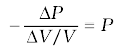
Hence, substituting in Eq. (15.16), we have
B = P
Therefore, from Eq. (15.19) the speed of a longitudinal wave in an ideal gas is given by,
v = (15.22)
This relation was first given by Newton and is known as Newton’s formula.
Example 15.4 Estimate the speed of sound in air at standard temperature and pressure. The mass of 1 mole of air is 29.0×10⁻³ kg.
Answer We know that 1 mole of any gas occupies 22.4 litres at STP. Therefore, density of air at STP is:
ρo = (mass of one mole of air)/ (volume of one
mole of air at STP)
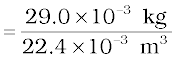
= 1.29 kg m–3
According to Newton’s formula for the speed of sound in a medium, we get for the speed of sound in air at STP,
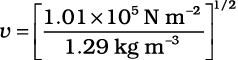 = 280 ms–1 (15.23)
The result shown in Eq.(15.23) is about 15% smaller as compared to the experimental value of 331 ms–1 as given in Table 15.1. Where
did wegowrong ? Ifweexaminethebasic assumption made by Newton that the pressure variations in a medium during propagation of sound are isothermal, we find that this is not correct. It was pointed out by Laplace that the pressure variations in the propagation of sound waves are so fast that there is little time for the heat flow to maintain constant temperature. These variations, therefore, are adiabatic and not isothermal. For adiabatic processes the ideal gas satisfies the relation (see Section 12.8),
PVγ = constant
i.e. ∆(PVγ ) = 0
or Pγ V γ –1 ∆V + Vγ ∆P = 0
where γ is the ratio of two specific heats,
Cp/Cv.
Thus, for an ideal gas the adiabatic bulk modulus is given by,
Bad =
= γP
The speed of sound is, therefore, from Eq. (15.19), givenby,
v = (15.24)
This modification of Newton’s formula is referred to as the Laplace correction. For air γ = 7/5. Now using Eq. (15.24) to estimate the speed of sound in air at STP, we get a value 331.3 m s–1, which agrees with the measured speed.

© 2026 GoodEd Technologies Pvt. Ltd.