The word efflux means fluid outflow. Torricelli discovered that the speed of efflux from an open tank is given by a formula identical to that of a freely falling body. Consider a tank containing a liquid of density ρ with a small hole in its side at a height y1 from the bottom (see Fig. 10.10). The air above the liquid, whose surface is at height y2, is at pressure P. From the equation of continuity [Eq. (10.10)] we have
v1 A1 = v2 A2
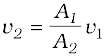
.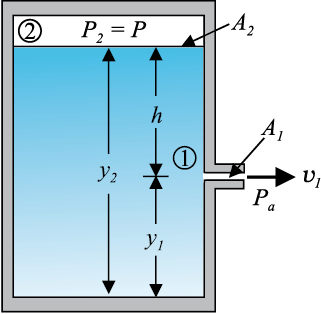
Fig. 10.10 Torricelli’s law. The speed of efflux, v1, from the side of the container is given by the application of Bernoulli’s equation. If the container is open at the top to the atmosphere then .
If the cross-sectional area of the tank A2 is much larger than that of the hole (A2 >>A1), then we may take the fluid to be approximately at rest at the top, i.e., v2 = 0. Now, applying the Bernoulli equation at points 1 and 2 and noting that at the hole P1 = Pa, the atmospheric pressure, we have from Eq. (10.12)

Taking y2 – y1 = h we have
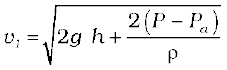 (10.14)
When P >>Pa and 2 g h may be ignored, the speed of efflux is determined by the container pressure. Such a situation occurs in rocket propulsion. On the other hand, if the tank is open to the atmosphere, then P = Pa and
 (10.15)
This is also the speed of a freely falling body. Equation (10.15) represents Torricelli’s law.

© 2026 GoodEd Technologies Pvt. Ltd.