In Section (9.3), we have seen that when a body is submerged in a fluid, it undergoes a hydraulic stress (equal in magnitude to the hydraulic pressure). This leads to the decrease in the volume of the body thus producing a strain called volume strain [Eq. (9.5)]. The ratio of hydraulic stress to the corresponding hydraulic strain is called bulk modulus. It is denoted by symbol B.
B = – p/(∆V/V) (9.13)
The negative sign indicates the fact that with an increase in pressure, a decrease in volume occurs. That is, if p is positive, ∆V is negative. Thus for a system in equilibrium, the value of bulk modulus B is always positive. SI unit of bulk modulus is the same as that of pressure i.e., N m–2 or Pa. The bulk moduli of a few common materials are given in Table 9.3.
The reciprocal of the bulk modulus is called compressibility and is denoted by k. It is defined as the fractional change in volume per unit increase in pressure.
k = (1/B) = – (1/∆p) × (∆V/V) (9.14)
It can be seen from the data given in Table 9.3 that the bulk moduli for solids are much larger than for liquids, which are again much larger than the bulk modulus for gases (air).
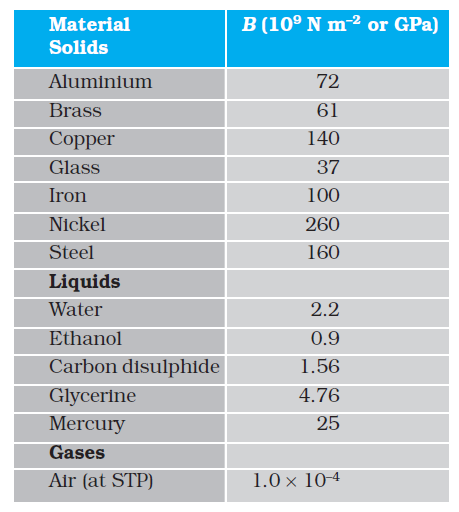
Table 9.4 shows the various types of stress, strain, elastic moduli, and the applicable state of matter at a glance.
Example 9.5 The average depth of Indian Ocean is about 3000 m. Calculate the fractional compression, ∆V/V, of water at the bottom of the ocean, given that the bulk modulus of water is 2.2 × 10⁹ N m–2. (Take g = 10 m s–2)
Answer The pressure exerted by a 3000 m column of water on the bottom layer
p = hρ g = 3000 m × 1000 kg m–3 × 10 m s–2
= 3 × 10⁷ kg m–1 s-2 = 3 × 10⁷ N m–2
Fractional compression ∆V/V, is
∆V/V = stress/B = (3 × 10⁷ N m-2)/(2.2 × 109 N m–2)
= 1.36 × 10⁻² or 1.36 % 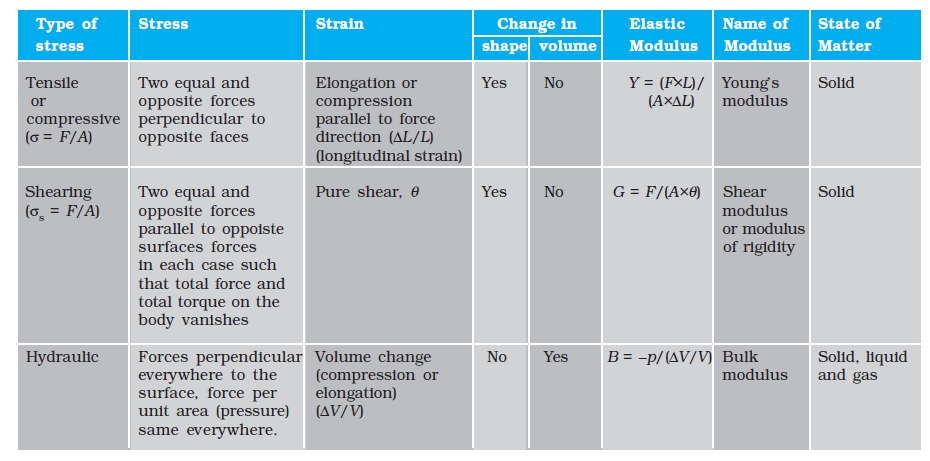
Table 9.4 Stress, strain and various elastic moduli


© 2026 GoodEd Technologies Pvt. Ltd.