Although the graphical method of adding vectors helps us in visualising the vectors and the resultant vector, it is sometimes tedious and has limited accuracy. It is much easier to add vectors by combining their respective components. Consider two vectors A and B in x-y plane with components Ax, Ay and Bx, By :
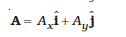
(4.18)
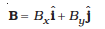
Let R be their sum. We have
R = A + B

(4.19a)
Since vectors obey the commutative and associative laws, we can arrange and regroup the vectors in Eq. (4.19a) as convenient to us :

Since
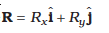
we have, 
Thus, each component of the resultant vector R is the sum of the corresponding components of A and B.
In three dimensions, we have
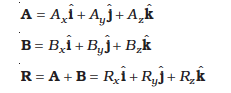
with 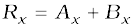
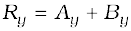
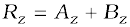
This method can be extended to addition and subtraction of any number of vectors. For example, if vectors a, b and c are given as
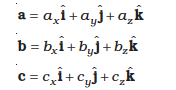
(4.23a)
then, a vector T = a + b – c has components :



* Note that angles α, β, and γ are angles in space. They are between pairs of lines, which are not coplanar.
Example 4.2 Find the magnitude and direction of the resultant of two vectors A and B in terms of their magnitudes and angle θ between them.
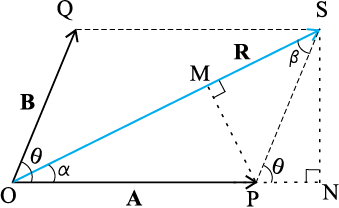
Fig. 4.10
Answer Let OP and OQ represent the two vectors A and B making an angle θ (Fig. 4.10). Then, using the parallelogram method of vector addition, OS represents the resultant vector R :
R = A + B
SN is normal to OP and PM is normal to OS.
From the geometry of the figure,
OS2 = ON2 + SN2
but ON = OP + PN = A + B cos θ SN = B sin θ
OS2 = (A + B cos θ)2 + (B sin θ)2
or, R2 = A2 + B2 + 2AB cos θ

In ∆ OSN, SN = OS sinα = R sinα, and in ∆ PSN, SN = PS sin θ = B sin θ
Therefore, R sin α = B sin θ
or, 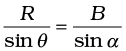
Similarly,
PM = A sin α = B sin β
or, 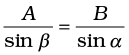
Combining Eqs. (4.24b) and (4.24c), we get
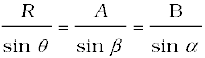
Using Eq. (4.24d), we get:
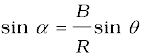
where R is given by Eq. (4.24a).
or, 
Equation (4.24a) gives the magnitude of the resultant and Eqs. (4.24e) and (4.24f) its direction. Equation (4.24a) is known as the Law of cosines and Eq. (4.24d) as the Law of sines.
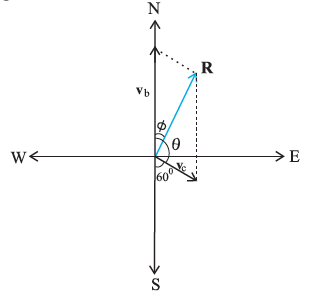
Example 4.3 A motorboat is racing towards north at 25 km/h and the water current in that region is 10 km/h in the direction of 60° east of south. Find the resultant velocity of the boat.
Answer The vector vb representing the velocity of the motorboat and the vector vc representing the water current are shown in Fig. 4.11 in directions specified by the problem. Using the parallelogram method of addition, the resultant R is obtained in the direction shown in the figure.
We can obtain the magnitude of R using the Law of cosine :


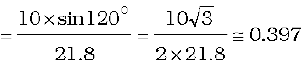
To obtain the direction, we apply the Law of sines 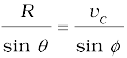
or, 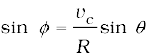


© 2026 GoodEd Technologies Pvt. Ltd.