The alkali metals show regular trends in their physical and chemical properties with the increasing atomic number. The atomic, physical and chemical properties of alkali metals are discussed below.
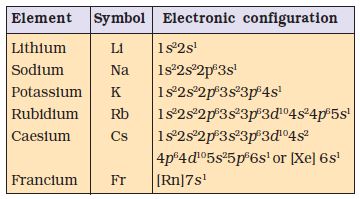
All the alkali metals have one valence electron, ns1 (Table 10.1) outside the noble gas core. The loosely held s-electron in the outermost valence shell of these elements makes them the most electropositive metals. They readily lose electron to give monovalent M+ ions. Hence they are never found in free state in nature.
The alkali metal atoms have the largest sizes in a particular period of the periodic table. With increase in atomic number, the atom becomes larger. The monovalent ions (M+) are smaller than the parent atom. The atomic and ionic radii of alkali metals increase on moving down the group i.e., they increase in size while going from Li to Cs.
The ionization enthalpies of the alkali metals are considerably low and decrease down the group from Li to Cs. This is because the effect of increasing size outweighs the increasing nuclear charge, and the outermost electron is very well screened from the nuclear charge.
The hydration enthalpies of alkali metal ions decrease with increase in ionic sizes.
Li+> Na+ > K+ > Rb+ > Cs+
Li+ has maximum degree of hydration and for this reason lithium salts are mostly hydrated, e.g., LiCl· 2H2O

© 2026 GoodEd Technologies Pvt. Ltd.