Movement by diffusion is passive, and may be from one part of the cell to the other, or from cell to cell, or over short distances, say, from the inter-cellular spaces of the leaf to the outside. No energy expenditure takes place. In diffusion, molecules move in a random fashion, the net result being substances moving from regions of higher concentration to regions of lower concentration. Diffusion is a slow process and is not dependent on a ‘living system’. Diffusion is obvious in gases and liquids, but diffusion in solids is more likely rather than of solids. Diffusion is very important to plants since it is the only means for gaseous movement within the plant body.
Diffusion rates are affected by the gradient of concentration, the permeability of the membrane separating them, temperature and pressure.
As pointed out earlier, a gradient must already be present for diffusion to occur. The diffusion rate depends on the size of the substances; obviously smaller substances diffuse faster. The diffusion of any substance across a membrane also depends on its solubility in lipids, the major constituent of the membrane. Substances soluble in lipids diffuse through the membrane faster. Substances that have a hydrophilic moiety, find it difficult to pass through the membrane; their movement has to be facilitated. Membrane proteins provide sites at which such molecules cross the membrane. They do not set up a concentration gradient: a concentration gradient must already be present for molecules to diffuse even if facilitated by the proteins. This process is called facilitated diffusion.
In facilitated diffusion special proteins help move substances across membranes without expenditure of ATP energy. Facilitated diffusion cannot cause net transport of molecules from a low to a high concentration – this would require input of energy. Transport rate reaches a maximum when all of the protein transporters are being used (saturation). Facilitated diffusion is very specific: it allows cell to select substances for uptake. It is sensitive to inhibitors which react with protein side chains.
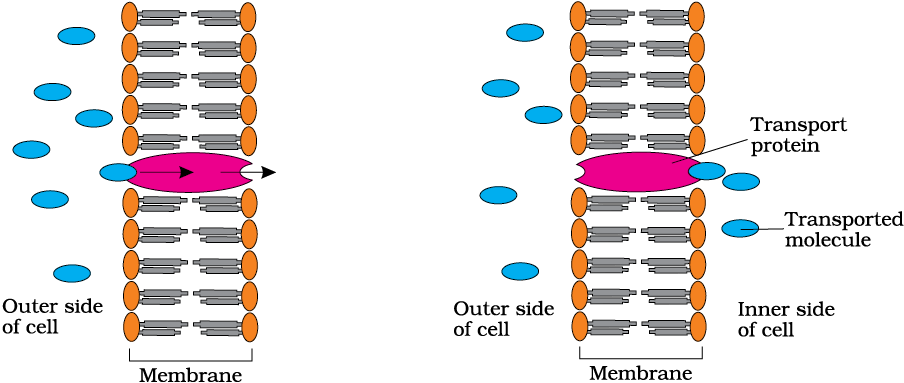
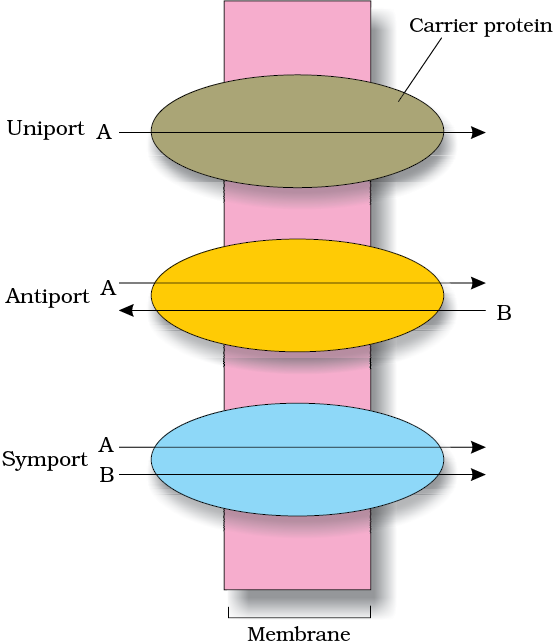
Figure 11.2 Facilitated diffusion
Figure 11.1 shows an extracellular molecule bound to the transport protein; the transport protein then rotates and releases the molecule inside the cell, e.g., water channels – made up of eight different types of aquaporins.

© 2026 GoodEd Technologies Pvt. Ltd.