Each flower normally has four floral whorls, viz., calyx, corolla, androecium and gynoecium (Figure 5.14).
The calyx is the outermost whorl of the flower and the members are called sepals. Generally, sepals are green, leaf like and protect the flower in the bud stage. The calyx may be gamosepalous (sepals united) or polysepalous (sepals free).
Corolla is composed of petals. Petals are usually brightly coloured to attract insects for pollination. Like calyx, corolla may also be gamopetalous (petals united) or polypetalous (petals free). The shape and colour of corolla vary greatly in plants. Corolla may be tubular, bell-shaped, funnel-shaped or wheel-shaped.
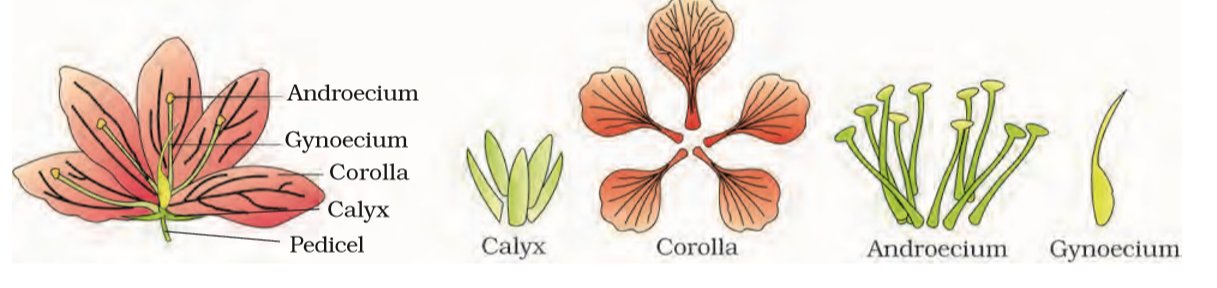
Figure 5.14 Parts of a flower
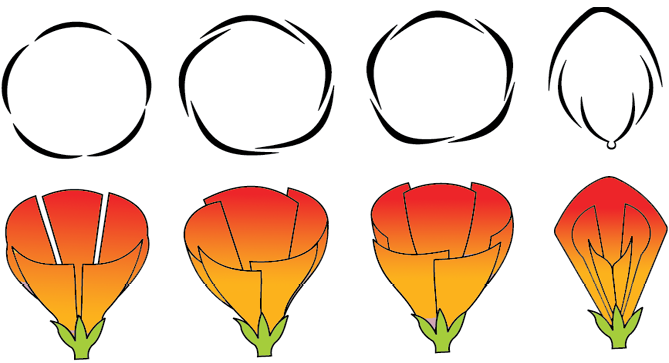
Aestivation: The mode of arrangement of sepals or petals in floral bud with respect to the other members of the same whorl is known as aestivation. The main types of aestivation are valvate, twisted, imbricate and vexillary (Figure 5.15). When sepals or petals in a whorl just touch one another at the margin, without overlapping, as in Calotropis, it is said to be valvate. If one margin of the appendage overlaps that of the next one and so on as in china rose, lady’s finger and cotton, it is called twisted. If the margins of sepals or petals overlap one another but not in any particular direction as in Cassia and gulmohur, the aestivation is called imbricate. In pea and bean flowers, there are five petals, the largest (standard) overlaps the two lateral petals (wings) which in turn overlap the two smallest anterior petals (keel); this type of aestivation is known as vexillary or papilionaceous.
(a) (b) (c) (d)
Figure 5.15 Types of aestivation in corolla : (a) Valvate (b) Twisted (c) Imbricate (d) Vexillary

© 2026 GoodEd Technologies Pvt. Ltd.