Select Chapter Topics:

 Q. No.
For the given circuit of the \(\mathrm{p\text-n}\) junction diode, which of the following statements is correct?

1.
In F.B. the voltage across \(R\) is \(V.\)
2.
In R.B. the voltage across \(R\) is \(V.\)
3.
In F.B. the voltage across \(R\) is \(2V.\)
4.
In R.B. the voltage across \(R\) is \(2V.\)


Subtopic: PN junction |
81%
Level 1: 80%+
AIPMT - 2002
Hints

Reverse bias applied to a junction diode:
| 1. | lowers the potential barrier |
| 2. | raises the potential barrier |
| 3. | increases the majority carrier current |
| 4. | increases the minority carrier's current |
Subtopic: PN junction |
75%
Level 2: 60%+
AIPMT - 2003
Hints
The barrier potential of a \(\mathrm{p\text-n}\) junction diode does not depend on:
| 1. | diode design | 2. | temperature |
| 3. | forward bias | 4. | doping density |
Subtopic: PN junction |
75%
Level 2: 60%+
AIPMT - 2003
Hints


Following diagram performs the logic function of:
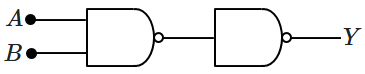
1. AND gate
2. NAND gate
3. OR gate
4. XOR gate
Subtopic: Logic gates |
80%
Level 1: 80%+
AIPMT - 2003
Hints

Unlock IMPORTANT QUESTION
This question was bookmarked by 5 NEET 2025 toppers during their NEETprep journey. Get Target Batch to see this question.
✨ Perfect for quick revision & accuracy boost
Buy Target Batch
Access all premium questions instantly
In a p–n junction photocell, the value of the photo electromotive force produced by monochromatic light is proportional to:
| 1. | the intensity of the light falling on the cell. |
| 2. | the frequency of the light falling on the cell. |
| 3. | the voltage applied at the p–n junction. |
| 4. | the barrier voltage at the p–n junction. |
Subtopic: PN junction |
61%
Level 2: 60%+
AIPMT - 2004
Hints
In semiconductors at room temperature:
| 1. | The valence band is completely filled and the conduction band is partially filled. |
| 2. | The valence band is completely filled. |
| 3. | The conduction band is completely empty. |
| 4. | The valence band is partially empty and the conduction band is partially filled. |
Subtopic: Energy Band theory |
72%
Level 2: 60%+
AIPMT - 2004
Hints


The truth table for the following network is:

| 1. |
|
|||||||||||||||
| 2. |
|
|||||||||||||||
| 3. |
|
|||||||||||||||
| 4. | None of the above |
Subtopic: Logic gates |
79%
Level 2: 60%+
AIPMT - 1999
Hints
Of the diodes shown in the following diagrams, which one of the diodes is reverse biased?
| 1. |  |
2. |  |
| 3. |  |
4. |  |
Subtopic: PN junction |
85%
Level 1: 80%+
AIPMT - 2004
Hints
Unlock IMPORTANT QUESTION
This question was bookmarked by 5 NEET 2025 toppers during their NEETprep journey. Get Target Batch to see this question.
✨ Perfect for quick revision & accuracy boost
Buy Target Batch
Access all premium questions instantly
Application of a forward bias to a \(\mathrm{p\text-n}\) junction:
| 1. | widens the depletion zone. |
| 2. | increases the number of donors on the n side. |
| 3. | increases the potential difference across the depletion zone. |
| 4. | increases the electric field in the depletion zone. |
Subtopic: PN junction |
58%
Level 3: 35%-60%
AIPMT - 2005
Hints


Identify the incorrect statement from the following:
| 1. | The resistivity of a semiconductor increases with an increase in temperature. |
| 2. | Substances with an energy gap of the order of \(10~\text{eV}\) are insulators. |
| 3. | In conductors, the valence and conduction bands may overlap. |
| 4. | The conductivity of a semiconductor increases with an increase in temperature. |
Subtopic: Energy Band theory |
81%
Level 1: 80%+
AIPMT - 2005
Hints
Select Chapter Topics:

© 2026 GoodEd Technologies Pvt. Ltd.