
 Q. No.
The product of the above reaction is ............

Choose the correct option
1. (a, b)
2. (b, c)
3. (c, d)
4. (a, d)


Which arenium ion is involved in the bromination of aniline?
.

Choose the correct option
1. (a, b, c)
2. (b, c, d)
3. (a, c, d)
4. (a, b, d)
Which of the following amines can be prepared by Gabriel synthesis?
a. Isobutyl amine
b. 2-Phenylethylamine
c. N-Methylbenzylamine
d. Aniline
Choose the correct option:
1. (a, b)
2. (b, c)
3. (c, d)
4. (a, d)


Which of the following reactions is/are correct?
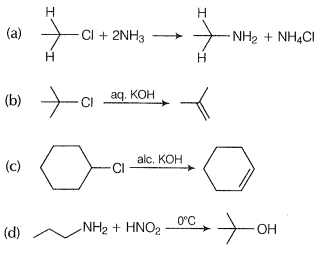
Choose the correct option
1. (a, b)
2. (b, c)
3. (c, d)
4. (a, c)
Under which of the following reaction conditions, aniline gives p-nitro derivative as the major product?
| a. | Acetyl chloride/pyridine followed by reaction with conc. H2SO4 + conc.HNO3 |
| b. | Acetic anhydride/pyridine followed by conc. H2SO4 + conc. HNO3 |
| c. | Dil. HCI followed by reaction with conc. H2SO4 + conc. HNO3 |
| d. | Reaction with conc. HNO3 + conc. H2SO4 |
Choose the correct option
1. (a, b)
2. (b, c)
3. (c, d)
4. (a, d)
Which of the following reactions belong to electrophilic aromatic substitution?
(a) Bromination of acetanilide
(b) Coupling reaction of aryldiazonium salts
(c) Diazotisation of aniline
(d) Acylation of aniline
Choose the correct option:
1. (a, b)
2. (b, c)
3. (c, d)
4. (a, d)


Match the reactions given in Column-I with the statements given in Column-II.
| Column-I | Column-II | ||
| A. | Ammonolysis | (i) | Amine with a lesser number of carbon atoms |
| B. | Gabriel phthalimide synthesis | (ii) | Detection test for primary amines. |
| C. | Hofmann bromamide reaction | (iii) | Reaction of phthalimide with KOH and R—X |
| D. | Carbylamine reaction | (iv) | Reaction of alkyl halides with NH3 |
Codes:
| A | B | C | D | |
| 1. | (ii) | (iii) | (iv) | (i) |
| 2. | (iii) | (i) | (iv) | (ii) |
| 3. | (i) | (iv) | (iii) | (ii) |
| 4. | (iv) | (iii) | (i) | (ii) |
Match the compounds given in Column I with the items given in Column II.
| Column I | Column II | ||
| A. | Benzene sulphonyl chloride | I. | Zwitter ion |
| B. | Sulphanilic acid | II. | Hinsberg reagent |
| C. | Alkyl diazonium salts | III. | Dyes |
| D. | Aryl diazonium salts | IV. | Conversion to alcohols |
Codes:
| A | B | C | D | |
| 1. | II | I | IV | III |
| 2. | III | I | IV | II |
| 3. | I | IV | III | II |
| 4. | IV | III | II | I |
| Assertion (A): | Acylation of amines gives a monosubstituted product whereas alkylation of amines gives a polysubstituted product. |
| Reason (R): | Acyl group sterically hinders the approach of further acyl groups. |
| 1. | Both (A) and (R) are true, and (R) is the correct explanation of (A). |
| 2. | Both (A) and (R) are True but (R) is not the correct explanation of (A). |
| 3. | (A) is True, but (R) is False. |
| 4. | (A) is False, but (R) is True. |


Given below are two statements:
| Assertion (A): | Hofmann's bromamide reaction is given by primary amines. |
| Reason (R): | Primary amines are more basic than secondary amines. |
| 1. | Both (A) and (R) are True and (R) is the correct explanation of (A). |
| 2. | Both (A) and (R) are True but (R) is not the correct explanation of (A). |
| 3. | (A) is True but (R) is False. |
| 4. | Both (A) and (R) are False. |

© 2026 GoodEd Technologies Pvt. Ltd.