- 1(current)
 Q. No.
The study of motion of objects, without consideration of its cause, is:
1. statics
2. kinematics
3. mechanics
4. dynamics
1. statics
2. kinematics
3. mechanics
4. dynamics


Subtopic: Distance & Displacement |
89%
Level 1: 80%+
Hints

When a particle's position changes, which of the following statements is true about its displacement and the distance it covers?
| 1. | Both cannot be zero. |
| 2. | Either one can be zero. |
| 3. | Both must be zero. |
| 4. | If one is positive, the other is negative, and vice-versa. |
Subtopic: Distance & Displacement |
55%
Level 3: 35%-60%
Hints
A particle moves along a path \(ABCD\) as shown in the figure. The magnitude of the displacement of the particle from \(A\) to \(D\) is:
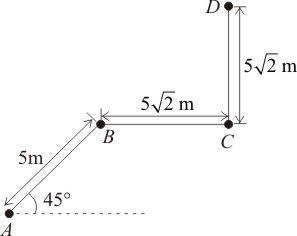
1. m
2. \(10\) m
3. m
4. \(15\) m
Subtopic: Distance & Displacement |
69%
Level 2: 60%+
Hints


A drunkard walking in a narrow lane takes \(5\) steps forward and \(3\) steps backward, followed again by \(5\) steps forward and \(3\) steps backward, and so on. Each step is \(1\) m long and requires \(1\) s. There is a pit on the road \(13\) m away from the starting point. The drunkard will fall into the pit after:
1. \(37\) s
2. \(31\) s
3. \(29\) s
4. \(33\) s
Subtopic: Distance & Displacement |
63%
Level 2: 60%+
Hints
Links
- 1(current)
Q. No.
© 2026 GoodEd Technologies Pvt. Ltd.