- 1(current)
 Q. No.
Unlock IMPORTANT QUESTION
This question was bookmarked by 5 NEET 2025 toppers during their NEETprep journey. Get Target Batch to see this question.
✨ Perfect for quick revision & accuracy boost
Buy Target Batch
Access all premium questions instantly
Which one of the following statement is wrong?
| 1. | When a conservative force does positive work on a body, the potential energy of the body decreases. |
| 2. | Work done by a body against friction always results in a loss of its kinetic energy. |
| 3. | The rate of change of the total momentum of a many-particle system is proportional to the sum of the internal forces on the system. |
| 4. | In an inelastic collision of two bodies, the total linear momentum of the system of two bodies does not change after the collision. |


Subtopic: Concept of Work | Work Energy Theorem |
57%
Level 3: 35%-60%
Hints
Links

A body of mass 0.5 kg travels in a straight line with velocity \(v = ax^{3 / 2 }\) where \(a = 5 m^{- 1 / 2} s^{- 1}\). What is the work done by the net force during its displacement from x = 0 to x = 2 m?
1. 50 J
2. 45 J
3. 68 J
4. 90 J
Subtopic: Work Energy Theorem |
68%
Level 2: 60%+
Hints
Links
Unlock IMPORTANT QUESTION
This question was bookmarked by 5 NEET 2025 toppers during their NEETprep journey. Get Target Batch to see this question.
✨ Perfect for quick revision & accuracy boost
Buy Target Batch
Access all premium questions instantly
A 1 kg block situated on a rough incline is connected to a spring of spring constant as shown in the figure. The block is released from rest with the spring in the unstretched position. The block moves 10 cm down the incline before coming to rest. The coefficient of friction between the block and the incline is:
(Assume that the spring has a negligible mass and the pulley is frictionless.)
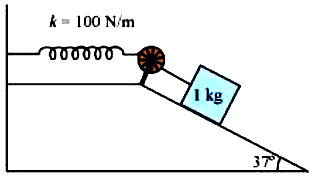
1. 0.03
2. 0.14
3. 0.11
4. 0.08
Subtopic: Work Energy Theorem |
Level 3: 35%-60%
Hints
Links


- 1(current)
Q. No.
© 2026 GoodEd Technologies Pvt. Ltd.