
- 1(current)
 Q. No.
| 1. | All the biological factors in the organism environment |
| 2. | The physical space where an organism lives |
| 3. | The range of temperature that the organism needs to live |
| 4. | The functional role played by the organism where it lives |


| List-I | List-II | ||
| A. | Migratory flamingoes and resident fish in South American lakes | I. | Interference competition |
| B. | Abingdon tortoise became extinct after introduction of goats in their habitat | II. | Competitive release |
| C. | Chathamalus expands its distributional range in the absence of Balanus | III. | Resource partitioning |
| D. | Five closely related species of Warblers feeding in different location on the same tree | IV. | Interspecific competition |
| 1. | A-I,B-IV,C-III,D-II | 2. | A-IV,B-I,C-II,D-III |
| 3. | A-III,B-I,C-II,D-IV | 4. | A-II,B-IV,C-III,D-I |

| 1. | 'a' represents exponential growth when responses are not limiting the growth; and 'b' represents logistic growth when responses are limiting the growth. |
| 2. | 'a' represents logistic growth when responses are not limiting the growth; 'b' represents exponential growth when responses are limiting the growth. |
| 3. | 'a' represents carrying capacity and 'b' shows logistic growth when responses are limiting the growth. |
| 4. | 'a' represents exponential growth when responses are not limiting the growth and 'b' shows carrying capacity. |


| Assertion (A): | Connell's elegant field experiment showed that on the rocky sea, the larger and competitively superior barnacles dominate the intertidal area and exclude the smaller barnacles from that area. |
| Reason (R): | Generally, herbivores and plants appear to be more adversely affected by competition than carnivores. |
| 1. | Both (A) and (R) are True and (R) is the correct explanation of (A) |
| 2. | Both (A) and (R) are True but (R) is not the correct explanation of (A) |
| 3. | (A) is True but (R) is False. |
| 4. | (A) is False but (R) is True. |
Sorry!! currently, the explanation for the question is not provided. If you need further help, please email at support@neetprep.com with subject: Explanation Missing for Question Id: 456895
Sorry!! currently, the explanation for the question is not provided. If you need further help, please email at support@neetprep.com with subject: Explanation Missing for Question Id: 456895
| 1. | 10 | 2. | 9 |
| 3. | 25 | 4. | 15 |
| List-I | List-II | ||
| A. | Logistic growth | I. | Unlimited resource availability condition |
| B. | Exponential growth | II. | Limited resource availability condition |
| C. | Expanding age pyramid | III. | The percent individuals of pre-reproductive age is largest followed by reproductive and post reproductive age groups |
| D. | Stable age pyramid | IV. | The percent individuals of pre-reproductives and reproductive age group are same |
| Options: | A | B | C | D |
| 1. | II | IV | III | I |
| 2. | II | I | III | IV |
| 3. | II | III | I | IV |
| 4. | II | IV | I | III |


Carnivorous animals - lions and leopards, occupy the same niche but lions predate mostly larger animals and leopards take smaller ones. This mechanism of competition is referred to as:
| 1. | Character displacement | 2. | Altruism |
| 3. | Resource partitioning | 4. | Competitive exclusion |
An association of individuals of different species living in the same habitat and having functional interactions is known as:
| 1. | Ecological niche | 2. | Biotic community |
| 3. | Ecosystem | 4. | Population |
The following graph depicts changes in two populations (A and B) of herbivores in a grassy field. A possible reason for these changes is that:
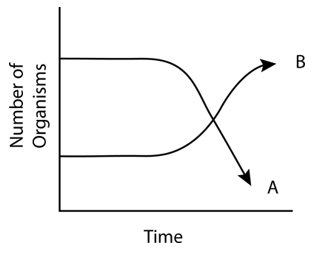
| 1. | both plant populations in this habitat decreased |
| 2. | population-B competed more successfully for food than population-A |
| 3. | population-A produced more offspring than population-B |
| 4. | population-A consumed the members of population-B |


According to Darwin, organic evolution is due to:
| 1. | Interspecific competition. |
| 2. | Competition within closely related species. |
| 3. | Reduced feeding efficiency in one species due to the presence of interfering species. |
| 4. | Intraspecific competition. |
- 1(current)
Q. No.
© 2026 GoodEd Technologies Pvt. Ltd.